2X your impact! Right now through December 21, your gift to the National Brain Tumor Society will be matched, dollar for dollar (up to $100,000), thanks to the generosity of the Maben-Davis Family Foundation. Breakthroughs can’t wait — make a gift today.
Cookie Policy
This website uses cookies that help the website function and that help us understand how you interact with it. Please read our privacy policy for more information.
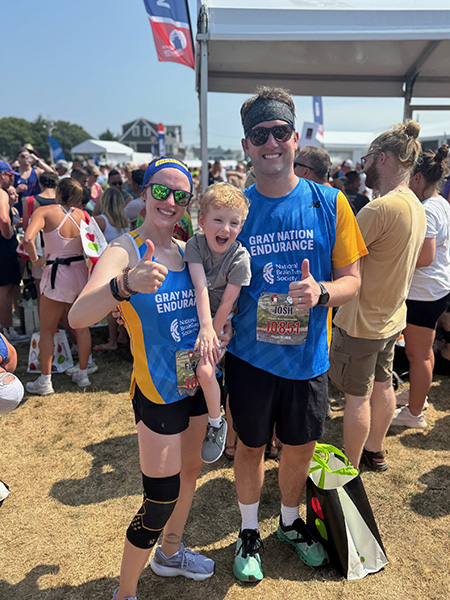
Elizabeth, left, and Josh, right, with their son Jack
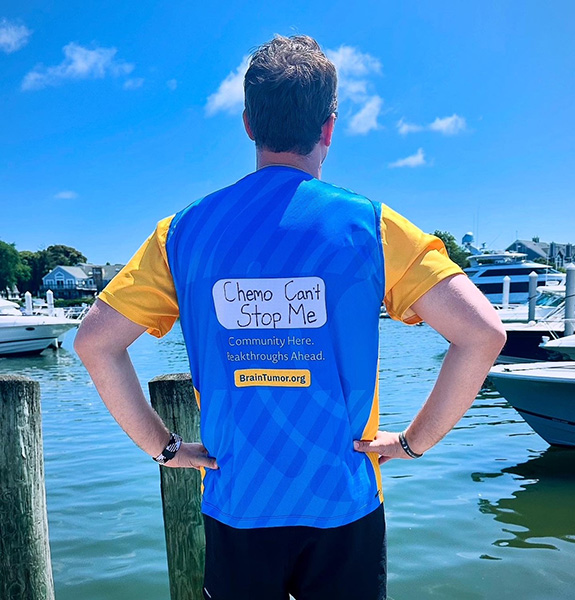
Each year, the Falmouth Road Race draws 10,000 runners to its iconic 7-mile seaside course. In 2025, 37 of those runners participated in the event as members of the National Brain Tumor Society’s Gray Nation Endurance® program, putting meaning behind their miles along the Cape Cod coast. With seven family members and friends by his side, brain tumor survivor Josh B. and his Unbreakable Brooks team raised nearly $32,000 to fuel breakthroughs ahead for the brain tumor community.
“Past National Brain Tumor Society funding helped propel forward a clinical trial I had enrolled in, and the organization will continue to help fund future trials,” Josh said. “Seeing NBTS out there advocating for brain tumor research funding on a federal level is important to me.”
As part of Josh’s team’s fundraising efforts, his brother-in-law Chris held an event called 48in24forJosh prior to the Falmouth Road Race. Chris and his girlfriend Ava ran 48 miles in 24 hours — two miles every hour — to encourage additional donations to NBTS. More than $9,000 of their team’s fundraising total came from that event alone.
“NBTS offered Chris a lot of advice on fundraising, which was helpful for him,” Josh said. “I found the monthly calls and weekly emails with different tips on how to raise money helpful.”
Even Josh’s dad joined the team, who had never run before.
“He was texting me about his training all summer, so it was a different way to connect with him,” Josh shared. “He did really well for a non-runner and trained all spring and summer for it, so that meant a lot.”
The Diagnosis
After a late night at an Eagles concert with flashing lights, Josh went for an afternoon run and felt a bit sluggish. Around dinner time, Josh experienced a grand mal seizure at home with his wife, Elizabeth, nearby.
“I woke up in the ambulance,” Josh said. “I really don’t remember the time between losing consciousness and getting to the ambulance.”
An MRI revealed an 8-cm. mass in Josh’s right frontal lobe. Josh went into surgery a few days later, and the neurosurgeon was able to remove, or resect, 85% of the tumor. A month after surgery, biomarker testing and pathology came back to say the tumor was grade 3 oligodendroglioma.
“I went to Dana Farber in Boston, and the team there explained that I was eligible for a trial medication called vorasidenib (Voranigo),” Josh said. “I was put on that medication for over a year, but then my tumor started growing in January 2025.”
Josh began radiation and chemotherapy, anticipating finishing his oral chemotherapy in March 2026. He has been taking a mix of lomustine and procarbazine, with hopes to finish all six planned cycles.
Quality of Life Challenges
Josh returned to work as a senior manager at the accounting firm PwC in March 2024. He said it was challenging at first to adjust back to work, but he had a supportive team at PwC that let him continue to prioritize his health. After about one year of healthy scans, showing no tumor progression, his MRI in January 2025 showed slight growth where the residual tumor remained. He went on leave to start treatment to address the tumor progression in early February 2025.
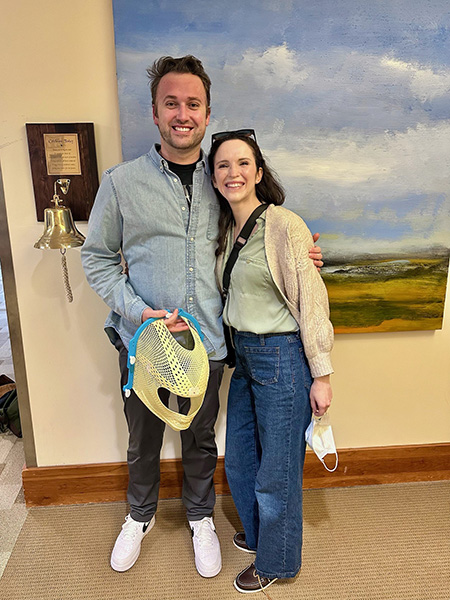
Josh’s last day of radiation therapy
Josh’s 33 radiation treatments went very well with little to no side effects. Since starting chemotherapy in May 2025, he has experienced tiredness and fatigue during each cycle that tends to improve towards the end of the cycle as his body recovers.
Josh also takes anti-seizure medication, prioritizes sleep, and refrains from drinking alcohol to keep his seizures at bay.
“I wasn’t able to drive for six months post-seizure, but I can drive now,” Josh said. “I have to limit my nighttime driving, and I try to limit how far I drive at a time. It’s hard being a young professional in the height of my career advancement and a young parent, worrying about whether I’ll be able to drive or not.”
Josh’s wife goes to work early in the morning so that she can return home by the afternoon when his fatigue worsens.
“Cancer fatigue is weird,” Josh said. “Your eyes feel really heavy. I track my water with the Waterllama app and focus on sleep and nutrition to help combat my fatigue.”
Nine months after his diagnosis, Josh found a therapist who helps coach him on parenting through treatment and other mental health matters.
“I see a therapist who works with cancer patients, and it has really helped me to have someone outside of my family to talk to about cancer,” Josh said. “A lot of my sessions revolve around parenting while undergoing cancer treatment. Parenting without cancer or chronic illness is stressful. On chemotherapy, some days I just don’t have the energy to parent a toddler. I find that to be the hardest part of this past year — keeping up an appearance that everything is OK.”
Staying Active After the Diagnosis
Elizabeth had severe preeclampsia when their son Jack was born. Josh said they started running races together to “help her process preeclampsia and being a new mom.” Josh has adopted a similar mentality in his fight against cancer.
The initial seizure that led to Josh’s diagnosis occurred shortly after he got home from a training run one day. A few weeks after surgery, Josh resumed physical activity. He even ran in his town’s turkey trot that Thanksgiving.
“I try to exercise 30 minutes a day to help me sleep, which is really important for brain tumor patients,” Josh said. “If my son Jack looks back someday, I want him to know I fought for a better prognosis and better life.”
After Josh’s recovery from surgery, his wife discovered Gray Nation Endurance (GNE), the official endurance program of the National Brain Tumor Society. They applied to run in the 2024 Falmouth Road Race as a member of GNE before returning to run the race in 2025.
“It’s nice having a community of people running ‘in memory of,’ or to honor their own journey,” Josh said. “I really enjoyed connecting with others who are in the brain cancer universe. I don’t know many people with brain cancer, so being part of NBTS’s Gray Nation has helped me see and hear from others who have been impacted by this, so I don’t feel as alone.”
Join Gray Nation Endurance
Join individuals around the country by applying for a Gray Nation Endurance charity team, like Josh did with the Falmouth Road Race, or by selecting a race or endurance activity of your choice. Whether you run, ride, swim, hike, or paddle for NBTS, you can celebrate a survivor, pay tribute to a loved one, or make an overall difference with your miles.
Kick off 2026 with a goal that challenges you to be part of something bigger and help fund critical research and support for those impacted by brain tumors.
“I got diagnosed when I had a 2-year-old, and you just start thinking about your life and what you might miss with his life — like his milestones based on your prognosis,” Josh said. “I don’t want someone else to go through that, and that’s one of the reasons why I fundraise for NBTS.”