This website uses cookies that help the website function and that help us understand how you interact with it. Please read our privacy policy for more information.
I was diagnosed in 2018. I was 27 years old at the time.
I was actually on vacation with a group of friends, and we were having a great time. We were in Las Vegas, and the last morning there — before driving to San Diego for the remainder of the trip — I woke up and noticed I was seeing double. It just wasn’t going away. At first, I chalked it up to having some drinks the night before, but I continued to see double. It wouldn’t go away.
My wife, who was my fiancée at the time, is an optometrist, so being an eye doctor, she knew something wasn’t quite right if it wasn’t going away. Once we arrived at our next destination, we went to an urgent care. They did some standard bloodwork, but nothing came back odd. By the end of the trip, it had been four straight days of me seeing double.
It was terrible. Especially being somewhere like San Diego, where you want to go sightseeing in the beautiful surroundings. I was basically walking around with one eye closed the whole time.
When we got home to Philadelphia, and it still hadn’t resolved, my wife said, “You should probably go to the hospital. Just go to the ER and get it checked out.” I went to Wills Eye Hospital, and they did the initial screening. My wife met me there after work and actually looked into the back of my eyes. She said, “It’s really cloudy back there. It doesn’t look right.”
Discovery of a Brain Tumor
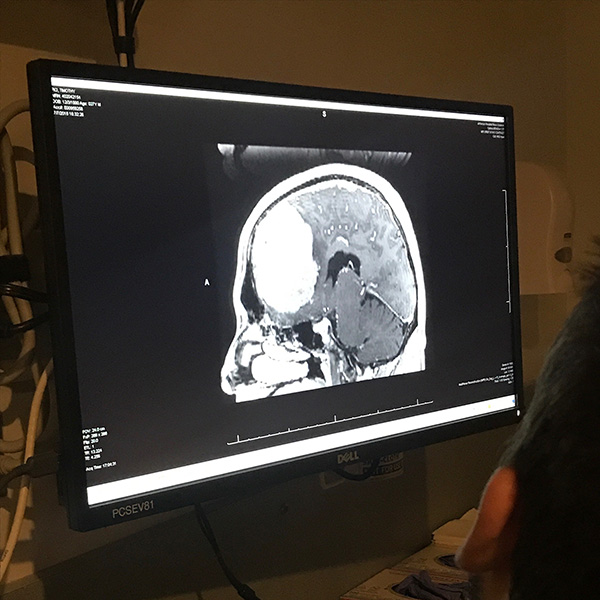
That led to a CT scan and an MRI. As soon as those came back, they told me I wasn’t leaving. They said, “We need to do surgery as soon as we can.” That’s when they found a large tumor the size of a grapefruit or a softball.
Everything happened so fast. It was difficult to process in real time. They told me they were going to do surgery the next day, and I remember saying, “Can I go home and come back tomorrow?” I was so naive. They said there was no way I could go home.
I had never even heard of meningioma before. They were pretty confident from the beginning that that’s what it was, and I never really worried that it was something else, like a glioma.
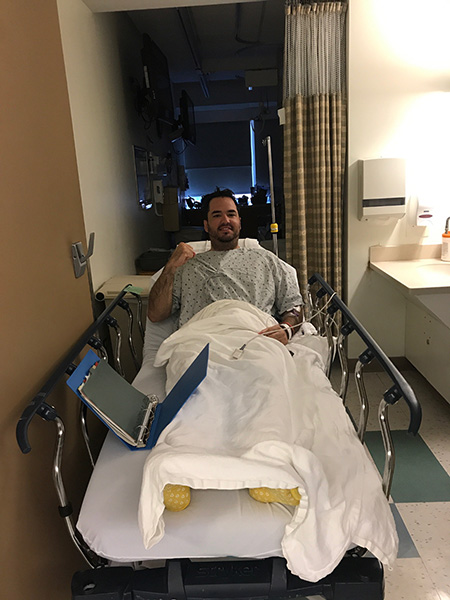
The surgery lasted eight or nine hours. I woke up in the ICU. The wrap on my head after surgery was extremely painful as it was way too tight. I remember telling one resident, and they didn’t think much of it, but then another one said, “Oh yeah, we can take this off.” That was a huge relief. I stayed in the hospital for about three or four days and really just wanted to get out as soon as possible.
They got as much of the tumor out as they could, but not all of it. I returned to work remotely once my swelling had subsided and my scar was healing. That way, I didn’t have to worry about my hour commute and trying to work. I spent at least a month working from home before coming back to the office. I was fortunate to have that opportunity.
At the time, I think I was in a bit of denial. I was thinking, “It’s over. This is done.” I didn’t really understand how common recurrence is, especially because mine was atypical, which has a higher chance of coming back.
Meningioma Recurrence
Two years later, in 2020, a scan showed recurrence. That’s when radiation came into the picture. It was a little bit of a shock, especially since the previous scans had been clean.
I had Gamma Knife radiation to target the one spot. The treatment itself was maybe 30 or 35 minutes. I had fatigue and a dull headache for a few days afterward, but nothing major.
Then, in 2024, it recurred again. This time, there were small recurrences in multiple spots. By then, we had moved from Philadelphia to Little Rock, Arkansas, and I had a new care team. Right away, they were talking about surgery, and that really threw me for a loop. I wasn’t prepared to hear that.
I knew I needed to get second opinions. I reached out to my original team and also went to a facility in Dallas that has a meningioma specialist. He told me he didn’t think surgery was necessary and that radiation was the right approach. The radiation oncologist there had actually trained at the same hospital where I had been treated before, so they were able to talk directly and put together a plan. Once that happened, everything became much clearer to me.
I had Gamma Knife again. One treatment had no side effects at all. Another time, I chose to stay on the table for a full hour instead of breaking it up. In retrospect, that was really challenging. Not because of the mask, but because of the pain in the back of my head from being on the table. The last five minutes felt like an eternity. If I had to do it again, I would break it up into shorter sessions.
Scanxiety After Diagnosis
Day to day, meningioma doesn’t affect my life. If anything, it’s helped me take my health more seriously. I’ve tried to live a healthier lifestyle, lose weight, and stay in good shape because if I ever need surgery again, I want to recover as well as possible.
What I wish people understood is that it’s a lifelong battle. The “benign is not fine” saying really resonates with me. You hear things like, “At least it’s not cancer,” and I am grateful for that. It absolutely could be worse, but that doesn’t mean it’s nothing. I’ve had brain surgery and radiation to my brain. There’s always scanxiety. Every scan brings a certain level of fear.
Let’s Talk About Meningioma
Each year, more than 39,000 Americans are diagnosed with meningioma — the most common type of primary brain tumor. Meningiomas originate from cells of the meninges, which are membrane layers that cover and protect the brain and spinal cord.
While often benign, these tumors can still cause serious health issues depending on their size and location. Let’s talk about what makes meningiomas different from other brain tumors and learn more about the experiences people living with this tumor type and their loved ones may face.
2X MATCH: YOUR GIFT GOES TWICE AS FAR THIS CHILDHOOD CANCER AWARENESS MONTH
Double your impact! Right now through Sept. 30, all gifts (up to $50,000) will be matched, dollar for dollar, thanks to the generosity of Susan and Dan Ryan, to fuel research, advocacy, and support for the pediatric brain tumor community.