This website uses cookies that help the website function and that help us understand how you interact with it. Please read our privacy policy for more information.
In 2002, Dallas Mathile was diagnosed with anaplastic ependymoma. Four years later, Dallas faced a recurrence. His neuro-oncologist, Mark Gilbert, MD, recognized that there was relatively little in the medical literature on this type of brain tumor. Refusing to accept the lack of available information and options, Dr. Gilbert proposed creating an international group of researchers who would, for the first time, collaborate to investigate this rare disease.
Mark Gilbert, MD
Generously supported by the Mathile family, Dr. Gilbert united a core group of top-tier experts known for their collaborative mindsets, including Drs. Richard Gilbertson, Kenneth Aldape, Terri Armstrong, and Amar Gajjar. Together, this nucleus formed the foundation of what would become the Collaborative Ependymoma Research Network (CERN) Foundation.
Two decades later, that initial spark has evolved into an organization that serves as a global resource for the ependymoma community, while fueling ependymoma research and advocacy. This year, we celebrate 20 years of progress since the CERN Foundation’s inception.
Joining the National Brain Tumor Society
In 2020, the CERN Foundation became a designated program of the National Brain Tumor Society (NBTS). This strategic move consolidated the world’s leading expertise in ependymoma with the nation’s largest brain tumor advocacy platform.
By transitioning from informal collaborations to a unified partnership, NBTS accelerated CERN’s efforts to streamline the path from laboratory discovery to clinical trials, expand patient support networks, and amplify this community’s voice on Capitol Hill.
Since joining forces in 2020, CERN has injected more than $1.3 million in ependymoma-dedicated research between three major signature projects and three co-sponsored fellowships.
Funding Ependymoma Research
The CERN Foundation was formed because little was known about this rare tumor type 20 years ago. At the time, ependymoma was often grouped broadly with other glioma research. In the decade following CERN’s inception, the cumulative number of publications on ependymoma nearly tripled.
Today, the CERN Foundation has been responsible for the publication of over 60 peer-reviewed papers in leading medical journals, thanks to the efforts of an international network of collaborators. This body of research has greatly advanced our understanding of ependymoma and left a lasting legacy for future investigators to build upon.
“I already knew that we owe much of our progress to our patients’ foundations, but prior to writing [a history of ependymoma] article, I was unaware of the sheer number of milestones in ependymoma research that CERN, in particular, has been instrumental in achieving,” said David Ghasemi, MD, MRes.
Key Research Accomplishments
Instead of just looking at how the cells appear under a microscope, CERN-affiliated researchers began to take into account the unique genetic and molecular features of the tumor cells. Scientists discovered that there aren’t just one or two types of ependymoma, but 10 distinct molecular subgroups that all behave differently and likely need different treatment approaches.
In 2026, CERN is continuing this pioneering work with a new research grant. Led by Eric Holland, MD, PhD, at the Fred Hutchinson Cancer Center, this multi-year grant will use advanced molecular analysis to map spinal ependymoma subtypes, including myxopapillary ependymoma. The project aims to reduce diagnostic uncertainty and lay the groundwork for future targeted treatments.
CERN established the Ependymoma Outcomes Study in 2009, creating the world’s largest collection of adult ependymoma tumor samples and patient data. Led by Terri Armstrong, PhD, and Liz Vera, this global resource has fueled numerous breakthrough studies and even helped integrate newly defined molecular entities into official World Health Organization (WHO) classifications. By connecting laboratory data with real patient histories, the repository directly informed the design of prospective clinical trials for recurrent ependymoma, bridging the gap between scientific discovery and improved patient care.
Through its groundbreaking CERN 08-02 clinical trial, CERN evaluated a new drug combination for adults with a recurrence of this rare disease. The results, published in Neuro-Oncology in 2021, led to the regimen being added to the National Comprehensive Cancer Network (NCCN) Guidelines.
This development created the first standard, data-backed treatment for adult patients with recurrent ependymoma. In doing so, it enabled insurance to recognize the drugs as an approved therapy and educated community hospitals treating adults with recurrent ependymoma about this valuable treatment option, ensuring patients receive consistent, high-quality care.
By providing early-stage seed grants and fellowships, CERN supported researchers trying to prove their foundational concepts, which they then leveraged to win multimillion-dollar federal grants. Over the past decade, this multiplier effect has supercharged ependymoma research:
From Seed Money to a $5 Million NCI Grant: A small CERN-funded seed grant achieved a 20x return on investment, unlocking a $5 million U54 grant from the National Cancer Institute (NCI) in 2019. The project was led by Richard Gilbertson, MD, PhD, at the University of Cambridge, and Eric Holland, MD, PhD, at the Fred Hutchinson Cancer Center, from 2019 to 2022, and built on prior work supported by the CERN Foundation. This funding shifted the research focus away from traditional chemotherapies toward safer, targeted treatments for pediatric ependymoma and created first-of-their-kind laboratory models to reliably test new drugs.
From a Pediatric Fellowship to a $3 Million NCI Grant: Discoveries made during a 2020 CERN Robert Connor Dawes Pediatric Fellowship by Chan Chung, PhD, in the laboratory of Sriram Venneti, MD, PhD, revealed how childhood brain tumors reprogram their own metabolism to survive and grow. This breakthrough provided the essential evidence needed to secure an esteemed $3 million R01 grant from the NCI to further study childhood posterior fossa group A (PFA) ependymoma. Recently, a new phase II clinical trial was launched based on work supported through Dr. Chung’s fellowship.
“CERN Foundation seed funding first introduced me to the field of ependymoma and made it possible for me to begin investigating its underlying mechanisms and potential therapeutic strategies,” Dr. Chung said. “With this initial support, I was able to initiate research focused on the epigenetic driver EZHIP in PFA ependymoma and explore new therapeutic concepts that would have been difficult to pursue through conventional funding. With this foundation, I later became a faculty member and was able to start my own laboratory, where we continue to study the molecular mechanisms of ependymoma.”
Raising Awareness of Ependymoma
Jess C.
With roughly 1,380 Americans diagnosed each year and an estimated 19,340 living with the disease, ependymoma is incredibly rare. One of the greatest challenges patients face is the lack of public awareness. As grade 2 myxopapillary ependymoma survivor Jess C. said, “You don’t even know it exists until your doctor says you have it.”
The CERN Foundation has spent the last 20 years building a global community framework by creating educational resources, sharing inspirational stories from community members, and launching Ependymoma Awareness Day.
“Not only did [CERN] help me navigate my diagnosis and find doctors, but [CERN] gave me a community to belong to,” Jess said. “I’ve heard so many stories that gave me hope. I once wrote that I felt lost in the ocean, and the CERN program rescued me from that storm. Because of your organization, my life has been set on a course of progress.”
Creating Educational Resources
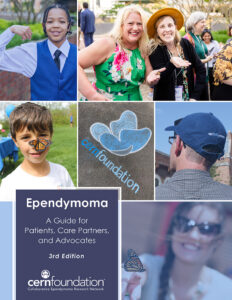
CERN brings top neuro-oncology experts directly to patients, translating complex science into clear information. The flagship resource is the Ependymoma Guide (now in its third edition) that covers everything from treatment options and clinical trials to symptom management and support resources. Other ependymoma resources include webinars and educational web content.
“My son was diagnosed with grade 2 ependymoma when he was seven,” said Jeannette N. “He was getting headaches and throwing up. It was devastating. The doctors were not hopeful. He had surgery and radiation and is cancer-free. It’s been 14 years since his diagnosis, and he is now thriving like a normal young adult. We are thankful for all the information we learned from CERN during that time.”
Sharing Inspiration Stories
By capturing and highlighting personal stories, CERN creates a space where patients and families can see their own experiences reflected. Sharing these stories brings vital awareness to the daily realities of living with ependymoma.
“Given the lack of knowledge about this rare tumor, it was challenging to make informed decisions about her treatment,” said Patrick E.*, whose teenage daughter was diagnosed with spinal ependymoma. “That search for information and hope led me to CERN.”
Patrick continued, “CERN was my safe harbor. Finding their resources and reading the inspirational stories on their website filled a massive void of knowledge. I realized we weren’t alone. CERN provided the balance of information, optimism, and realism I desperately needed to believe my daughter had a shot at a future.”
Ependymoma Awareness Day
Established by CERN in 2012, Ependymoma Awareness Day (EAD) is an annual initiative that unites patients, survivors, caregivers, and researchers worldwide to raise awareness of the community’s unmet needs. On this day, people participate in butterfly-themed activities to honor loved ones with ependymoma, recognize care partners and clinicians, and support ependymoma research efforts.
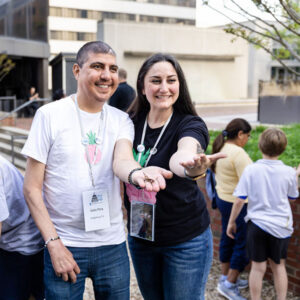
Julio & Liz P. in 2023
“I like to call ependymoma survivors unicorns because there are so few of them,” said Liz P., whose husband, Julio, passed away from anaplastic ependymoma. “The butterfly release was like a unicorn convention. There were so many ependymoma survivors, and it was great to get to meet them.”
The delicate and beautiful butterfly was chosen to represent the spirit of the ependymoma community as a symbol of hope through change. Just as a butterfly dramatically changes its shape, so can the meaning of hope along this journey.
“I see how ependymoma has upended my life,” said Tiffany M., who was diagnosed with grade 2 ependymoma. “I feel like Ependymoma Awareness Day casts a spotlight on the gift of hope. Hope that if you’re in the middle of it, there are people there who want to support you and navigate for you. Hope that in the future, they will come up with the means to either eradicate it, cut down the number of cases, or have a gentler treatment for it.”
Championing the Ependymoma Community
The CERN Foundation continues to champion the ependymoma community through one-on-one support and advocacy.
Patient Support & Navigation
The CERN Foundation, in partnership with NBTS, offers complimentary, specialized guidance to help families seek second opinions, evaluate clinical trials, and find expert neuro-oncologists who understand the nuances of ependymoma.
Since joining NBTS in 2020, over 450 ependymoma families have received direct, personalized navigation. The primary reasons families reach out are for guidance on obtaining second opinions and finding clinical trial options to help them make informed decisions about their care.
Sadie P.* used to stay up until 2 a.m. to research clinical trial options after her son, who had recurrent ependymoma, went to bed.
“[The patient navigator] was able to say, ‘Let me take this off your hands. Let me do that legwork and present you with some clinical trial information summaries,’” Sadie said. “It took a load off because she took the time to do that when I didn’t have the time but needed the information.”
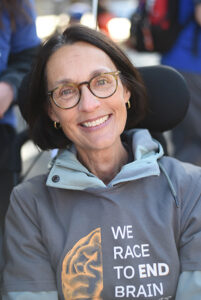
Tiffany M.
There is not always a clear road map for people navigating care after treatment and throughout survivorship. Although Tiffany M. has consulted with multiple institutions for expert opinions about her grade 2 ependymoma, she still needed a provider to help manage ongoing issues impacting her quality of life. Tiffany reached out to CERN for support. The Personalized Support and Navigation team worked with her to identify a neuro-oncology provider willing to join her care team.
“That just shows the heart behind the foundation,” Tiffany said. “The whole organization has been a tremendous encouragement. Not just a source of information, but there’s this personal contact that I think is so important, especially the rarer the cancer is.”
Advocacy
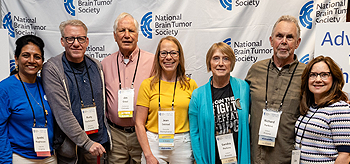
NBTS’s annual Head to the Hill event brings patients, survivors, and caregivers directly to policymakers to advocate for federal funding for medical research and policy changes. Even before the CERN Foundation officially joined NBTS, representatives participated in Head to the Hill each year to ensure the voices of the ependymoma community were heard.
“I call myself a Petri dish because my tumor is so rare,” said Shawn W., who was diagnosed with posterior fossa group B (PFB) ependymoma in 2021. “But when I went to Head to the Hill and I met people who actually had my surgery done in the same area, it made me feel normal because they had the same symptoms I had or were dealing with the same stuff I am at this point.”
* Note: Name was changed to protect the privacy of the caregiver.
Support CERN
Help us celebrate CERN’s accomplishments over the past two decades and ensure future families receive resources and personal navigation support while benefiting from the latest ependymoma research.