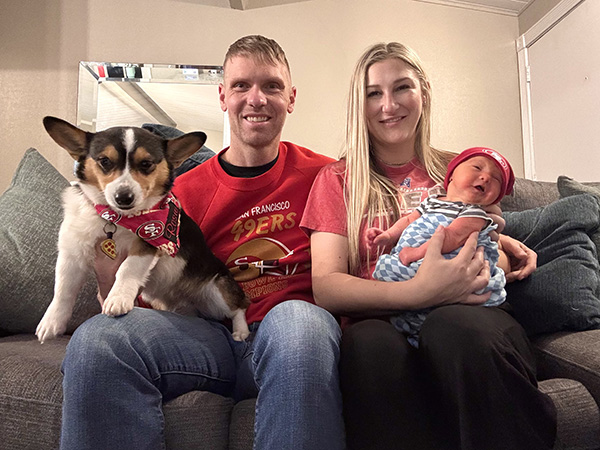
When Nick A. looks at his newborn son, Arthur, born in January 2026, he sees the world through a lens of profound gratitude.
“He just recently started making eye contact with me, which has been really special,” Nick said.
For Nick, the road to fatherhood was paved with the unique and often invisible hurdles of a young adult navigating a brain tumor. In an age when many 30-somethings are focused on career growth and starting families, Nick was relearning how to speak and questioning his own mortality.
An Isolating Diagnosis
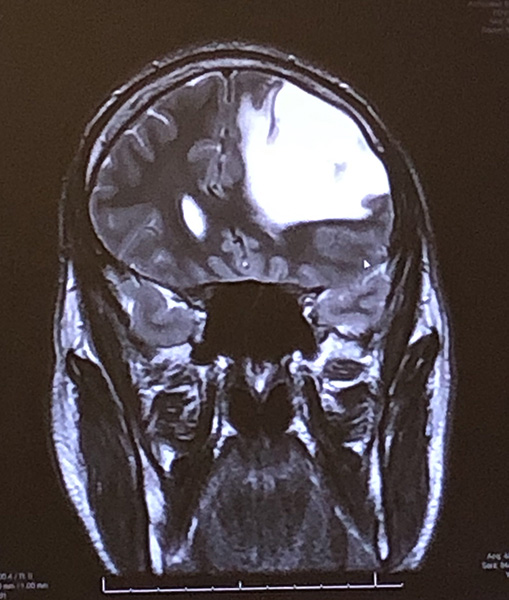
The journey began at the height of the COVID-19 pandemic in April 2020. Then 32, Nick suffered a midnight seizure that sent him falling from his bed. A CT scan revealed a mass the size of four golf balls in his left frontal lobe — later diagnosed as grade 2 astrocytoma.
“Nobody could visit me because of COVID, so I was very isolated at the hospital after surgery,” Nick said. “The tumor was in a part of my brain that affected speech, making communication difficult. Thinking back to the hospital FaceTimes with my family and fiancé, who couldn’t visit me in person, I realize how distressing it must have been for them.”
In those moments, Nick could understand what people were saying to him, but he could not find the right words to respond. He describes it as trying to learn English again. His speech-language pathologist recommended describing the circumstances around a word when he couldn’t recall it exactly. For example, if he couldn’t find the word “water,” he would instead say, “It’s something wet and clear that you drink.”
“Talking around the word would eventually lead me to the word,” Nick shared.
Along the way, Nick learned some tricks to ease his recovery as he navigated memory challenges. After a conversation with someone, he would immediately add their name to his phone for reference.
“My mom is a librarian and children’s book author, and we used to do Zoom calls together during the pandemic,” Nick said. “We would both read an article. She would ask me questions about what I read, and I’d summarize the main points. I’ve always loved to read, so regaining that skill felt especially important.”
Life After Surgery
When Nick finally returned home two weeks after surgery, he developed a cerebral spinal fluid (CSF) leak, which his neurosurgeon had warned was a potential post-op complication. It required an overnight stay and restitching of the surgical site.
Several weeks after that hospital visit, Nick went back to the ER via ambulance for severe leg pain. There, they discovered deep vein thrombosis (DVT), a serious blood clot that can occur in the days or weeks after surgery, which requires blood thinners.
“I would say the first three to six months after the surgery were pretty traumatic because of these health setbacks,” Nick said. “I don’t know if I had PTSD, but I definitely thought a lot about my experience and how isolating it was to be in the hospital.”
Nick returned to work as a film production manager in September 2020, five months after surgery.
“It was probably too early to go back to work because I was concerned that I couldn’t communicate well enough,” Nick said. “Dealing with speech and memory issues, along with new COVID-related film production protocols, resulted in a crazy amount of anxiety during my first job after surgery.”
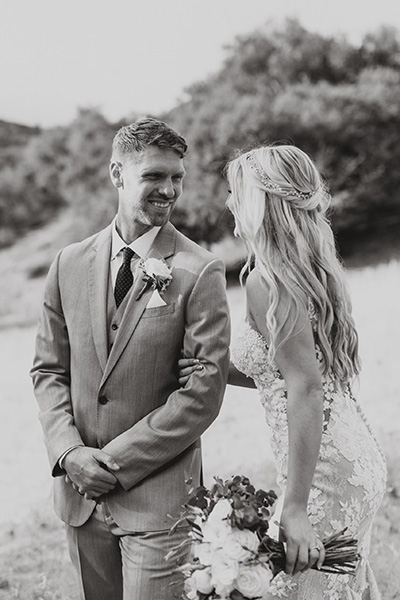
In addition to recovery and work, Nick and his fiancé Ashley also had to postpone their wedding twice due to the pandemic. They eventually married in May 2021 and went on their honeymoon in Israel the following year.
Tumor Regrowth as a Young Adult
Nick was again faced with the unique challenge of being a young adult living with a brain tumor in 2024, when doctors detected tumor regrowth.
At the time, the FDA had just approved vorasidenib (Voranigo) for the treatment of adults like Nick who have grade 2 astrocytomas with an IDH1 or IDH2 mutation. This new development allowed Nick to start treatment, but not before taking steps to address fertility preservation. After a discussion with his doctor, Nick froze his sperm, which was ultimately used to bring baby Arthur into the world via IVF in 2026.
“Voranigo has been incredibly successful for me,” Nick said. “Every time I go for an MRI, my neuro-oncologist says my tumor regrowth is shrinking. I’m grateful to not have side effects and avoid surgery, chemo, or radiation.”
Finding Community
For several years, Nick didn’t know anyone else with a brain tumor. That changed when he happened to visit a local brewery with his wife Ashley and met a group of people wearing brain tumor 5K shirts. He talked to them and learned about the National Brain Tumor Society (NBTS).
“That’s when it hit me,” Nick said. “I had felt so alone during this period. It didn’t even occur to me that there was a community of people overcoming and dealing with the same things I was dealing with.”
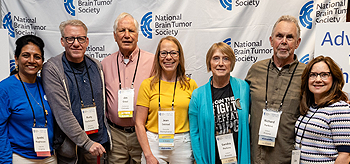
Nick has since become a fixture in NBTS’s monthly virtual Brain Tumor Support Conversations.
“The group has been really comforting, because you can talk about whatever your issues are, and there’s no judgment,” Nick said. “I appreciate having conversations with people who’ve gone through the same thing.”
Southern California Brain Tumor Walk
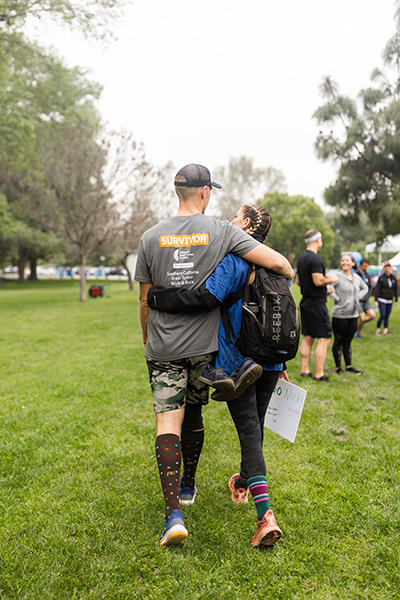
Inspired by his first Southern California Brain Tumor Walk in 2024, Nick returned in 2025 as the on-stage survivor speaker.
“I’m very motivated to talk about my experience because I know it can help people,” Nick said.
Nick acknowledges that he has directly benefited from brain tumor research and wants to ensure more opportunities in the future. In fact, NBTS played multiple roles in advancing Voranigo, including funding Memorial Sloan Kettering Cancer Center-supported laboratory work that helped propel this research from a phase II to a phase III trial.
“Voranigo is available because of years of groundbreaking research,” Nick said. “Being able to take a drug every night instead of surgery, chemo, or radiation has been really phenomenal. I’m committed to fundraising as well as spreading awareness about brain tumors and the need for ongoing research so drugs like Voranigo can exist.”
Today, Nick gets MRIs every three months and takes his medication every night. But his focus isn’t on the tumor, it’s on his growing family. His experience has taught him that while a brain tumor affects everyone differently, the need for community and a hopeful future remains universal for young adults like him.