This website uses cookies that help the website function and that help us understand how you interact with it. Please read our privacy policy for more information.
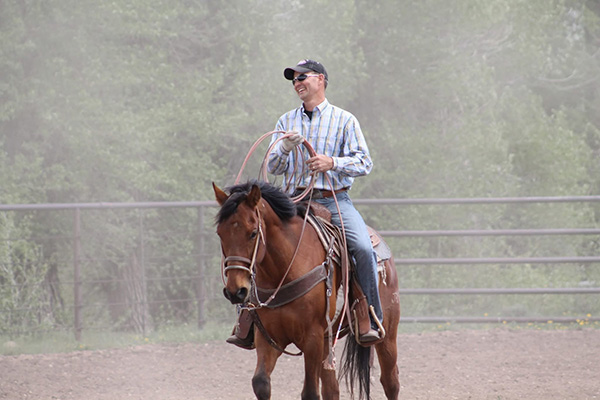
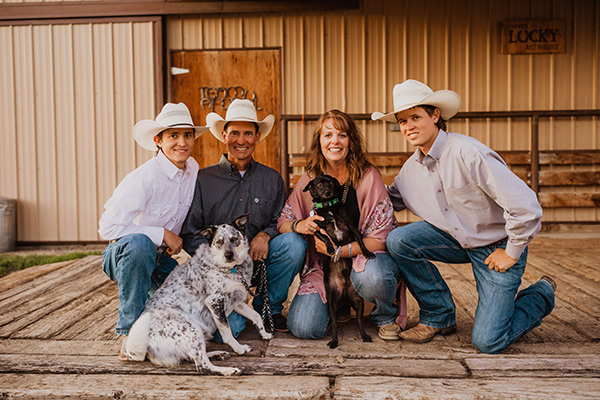
Juel A. loved nothing more than being outside on a horse, especially when he could take his two boys, Canton and Blake, to rodeos and teach them how to rope. By day, he taught business at a local high school in a small Wyoming town and helped place seniors in real-world job opportunities through a community resource training program. That all changed when Juel was diagnosed with glioblastoma in October 2017.
“When he got sick, the outpouring of love from former and current students, as well as the district, was overwhelming,” his wife Tami said. “I knew down deep in my heart that he was always a really good teacher, but the love and support from current and former students made us burst with pride for the impact he made on so many students.”
A Seizure at Work
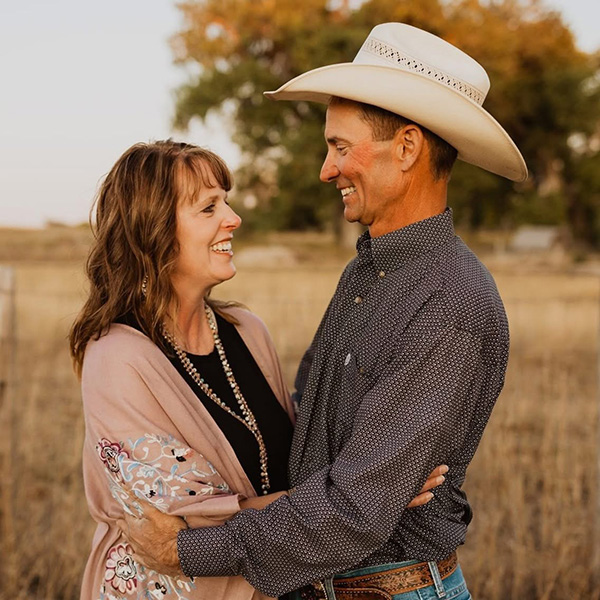
Tami and Juel
Juel was rarely sick, and when he was, his mindset was “sweat it out or rub some dirt on it,” according to Tami. One day, he admitted to Tami that he wasn’t feeling like himself and said, “I can’t really put into words how I’m feeling, but I think it’s probably time to get this heart thing done. Just staring at my computer screen is really starting to bother my eyes, and I just feel tense and on edge.”
Assuming it was due to an existing racing heart issue, Tami and Juel spent a few weeks investigating cardiologists and landed on a specialist two hours away in Colorado. Two days before his scheduled appointment, Juel had a seizure while working at the high school.
“We got up to the hospital in our small town, and I’m still thinking this is all related to his heart condition, but I don’t understand why he had a seizure because of his heart,” Tami said. “The ER doctor told me they found two masses — one above his left ear and one toward the top of his head in the center.”
The doctor then informed Tami that they would need to fly him to a center in Denver, three hours away, where they were equipped to handle his care. Tami and her sons could not join him in the helicopter, so they had to drive separately.
“Watching them take off in that helicopter with him in it — and alone — was just a sick feeling,” Tami said.
“It’s Glioblastoma”
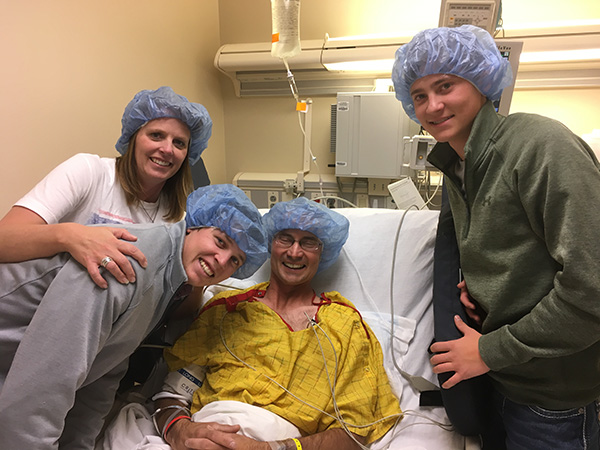
Juel with Tami and their boys
Juel underwent brain surgery two days after his seizure, which is when his neurosurgeon informed the family that it was glioblastoma — something Tami had never heard of before.
“It was just gut-wrenching,” Tami said. “I remember sitting on this couch with the boys — 16 and 20 — on each side of me, just crying into me. It was terrible.”
They lived in rural Wyoming, but his neuro-oncologist was three hours away in Denver, so the lack of access to high-quality care nearby and the necessary travel made life complicated.
“Juel wanted to be at home,” Tami said. “He wanted to look outside his window and see the horses out there. He wanted to do chores. He wanted to sleep in his own bed.”
Juel was able to complete his radiation therapy treatments in Nebraska, about 35 miles away, but he experienced another seizure near the end of his radiation treatment.
“They kept him in the hospital to finish out his radiation treatments,” Tami shared. “I feel like that’s when he regressed the most, and he had trouble reading after that.”
Access to Care
Over and over again, Tami ran into challenges with accessing high-quality care for Juel. During the COVID pandemic, Tami had to transfer Juel’s care from Denver to a closer oncologist, who was still 80 miles away.
One week after his son Blake graduated from high school, they met with a hospice nurse.
“We had to get a hospice program out of Nebraska,” Tami said. “If we needed them, it took them 45-60 minutes to get to us. That was a real limitation. These small communities don’t have access to hospice care.”
When Juel passed away on July 5, Blake called the hospice nurse to inform them of his passing, and they had to wait over an hour for her to get there and declare his death before the funeral home could come.
“He wanted to be home, and all three of us did that for him,” Tami said. “We were grateful to do it for him. I think that’s the best gift we could give him, by allowing him to die the way he wanted, at home.”
A Brain Tumor Advocate
“When I was in the thick of everything, there was too much information coming at me from many directions, and I couldn’t zero in on it at the time,” Tami said. “It was just too overwhelming for me.”
In fact, she distinctly recalls a moment of self-care near the end when she told her son that she needed to run to the bank and post office.
“I remember sitting in the vehicle for five glorious minutes of nothingness,” Tami said. “At the time, I didn’t think about myself, but I do remember that one day of just getting into the car, driving the five minutes into town and back, and remembering to take a breath.”
After Juel passed away, Tami resumed her master’s program. Her final class required an encapsulating project and paper. Tami focused her thesis on how advocacy leads to real change. Through this project, Tami interviewed a National Brain Tumor Society staff member and became immersed in the NBTS website to write the paper and create the presentation.
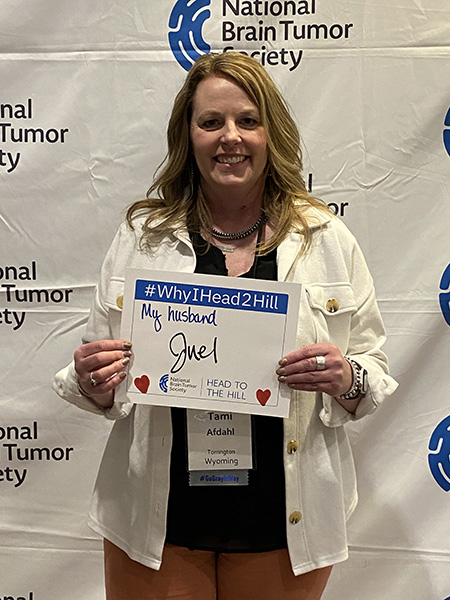
“It took me a while, but I finally signed up to be an advocate because I felt it was something Juel wanted me to do, in a way, to tell his story,” Tami said. “Juel handled glioblastoma with such dignity and grace, and he wanted to help others through the end. He was more concerned about others than himself, so I just want to do what I can.”
Through her advocacy, Tami hopes to raise awareness of the need for increased brain tumor research funding.
“One of the reasons advocacy is so important to me is that our brain is such a vital function of everything we do,” Tami said. “We have so many smart, educated, talented people who lose so much of themselves. They lose functions, personalities, memories, recall, and the ability to speak. We don’t do enough for that. We can do better, and I want to help us do better.”
A Meeting with Senator Barrasso
One of Tami’s early actions as a brain tumor advocate was participating in a virtual meeting with Senator John Barrasso.
“Senator Barrasso is really visible in our state, and I knew how passionate he was about care,” Tami said. “But the first time I met with him, it caught me off guard because it never occurred to me that someone would come to a meeting with this woman from Torrington, WY, so prepared and knowing so much about my background and what we’d been through.”
The first meeting with Sen. Barrasso was an emotional one for Tami.
“I wanted to do the meeting justice, be respectful of his time, represent the National Brain Tumor Society well, and not flub up on any of the facts and information,” Tami said. “He was so kind and supportive.”
When Tami met with Sen. Barrasso again the following year, he talked about his wife, Bobbi, who had been diagnosed with glioblastoma. (She later passed away in 2024.)
“I was honored that he shared his story with me, and it was a privilege to support him in the same way he supported me in the previous meeting,” Tami said.
The BRAIN Act
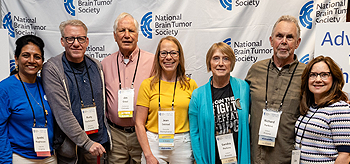
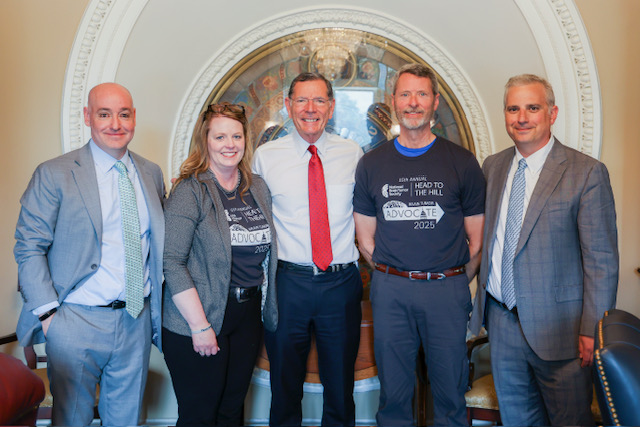
Tami, second from left, with Senator Barrasso, middle, alongside NBTS board members Frank Macchiarola, left, and Chris Brown, second from right
Senator Barrasso became one of the original co-sponsors of the Bolstering Research And Innovation Now (BRAIN) Act when it was first introduced in 2024 and then when it was reintroduced in 2025. The BRAIN Act is a landmark, bipartisan, and bicameral piece of legislation designed specifically to meet the unique needs of brain tumor researchers, clinicians, patients, and survivors.
“I’m so grateful that he did that — for his wife, for my husband, and for the entire community,” Tami said. “This May, I was able to sit in his office in Washington, D.C., to discuss it, shake his hand, and tell him thank you in person. That was a real special moment.”
The BRAIN Act aims to advance the quest to defeat brain tumors, once and for all, by increasing research funding, fostering collaboration, promoting critical awareness efforts, and supporting innovations in and access to care.
“We’ve got some great support from Senator Barrasso and other key legislators,” Tami said. “I’m ready to be aggressive and fight alongside them. Let’s go and do something. It’s been too long without a change in the standard of care and treatment options, and we need to do better.”
NBTS hosts two advocacy events each year to give brain tumor advocates like Tami the opportunity to meet with their members of Congress — the in-person Head to the Hill in May and the virtual Advocate From Your State in September.
“I sat on the sidelines for a couple of years just watching because I thought this little voice from Torrington, WY, didn’t matter,” Tami said. “But it does. Every voice matters, and it’s been such a wonderful experience. I have loved my jobs and feel like I make an impact at work, but I get a different sense of fulfillment every time I get off a call or walk out of a room from one of those [advocacy] meetings. It feels like important work and that I just did something that really mattered.”
Advocate for the BRAIN Act
Be a voice for the brain tumor community in your state!
Become an advocate like Tami and share your story to urge Congress to advance patient-first policies, such as the BRAIN Act, and to increase federal funding for brain tumor research.