This website uses cookies that help the website function and that help us understand how you interact with it. Please read our privacy policy for more information.
For the Rubenstein family, the Bolstering Research And Innovation Now (BRAIN) Act isn’t just a piece of legislation. It represents a vision where no family has to navigate the complexities of life after a brain tumor diagnosis alone.
“It all comes back to hope,” Paul said. “The BRAIN Act means to me that there’s some hope out there.”
Paul and his daughter, Libby, know that after a brain tumor diagnosis, the path forward is long and often requires a lot of support. Now a college junior, her experience with medulloblastoma and posterior fossa syndrome has included a lifelong list of challenges: double vision, right-sided weakness, slurred speech, and ataxia.
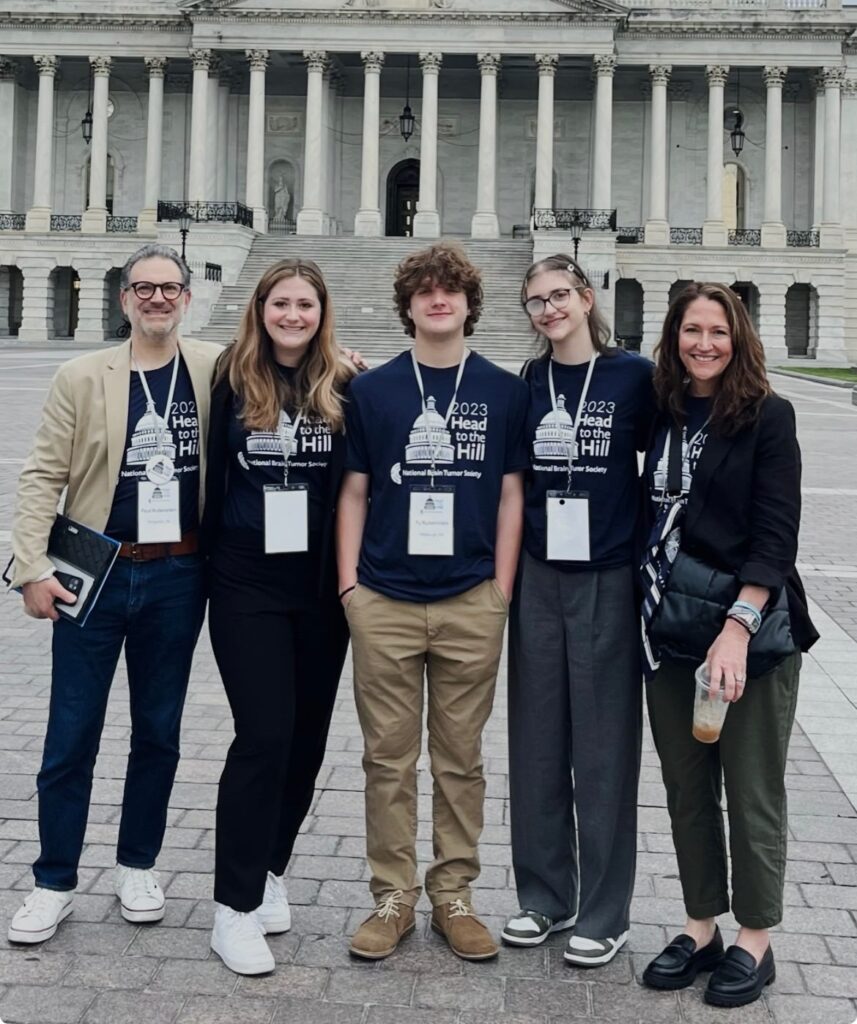
The Rubenstein family travels to Washington, D.C., for Head to the Hill® each year to represent the more than 1 million Americans living with a brain tumor. By sharing their story, they urge Congress to bridge the gap in survivorship care through the BRAIN Act.
Addressing Brain Tumor Survivorship
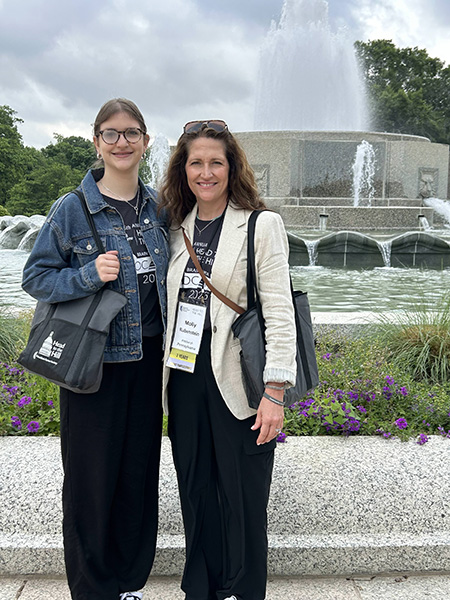
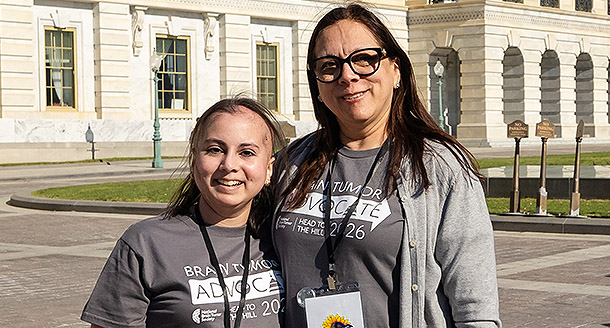
Libby with her mom, Molly
One provision of the BRAIN Act addresses the need to develop model systems of care for brain tumor survivors. Quality of life for patients varies significantly, and with so many survivors facing diverse long-term effects, the bill seeks to innovate how survivorship care is delivered during palliative treatment as well as in educational, social, and family settings.
“The posterior fossa syndrome symptoms did not go away 100%,” Paul shared. “She has double vision, so she has to wear a frosted patch on her glasses to help her see. Her speech is still a bit slurred, so she has to really enunciate and take care when she’s speaking.”
Recently, long after her treatments had ended, Libby lost her balance and fell on the ice, requiring her to crawl over to a car to use it to stand up. While she was not seriously injured, it’s an example of the ongoing difficulties she still faces.
This is why the BRAIN Act is so critical. It would provide funding through the National Institutes of Health (NIH), including the National Cancer Institute’s Office of Cancer Survivorship, to foster needed innovation in health care delivery for monitoring and caring for adult, adolescent, and pediatric brain tumor survivors throughout their lifespan.
“With the many challenges Libby still faces today, this piece of the bill really resonates with our family because we want a better quality of life for patients like Libby after treatment,” Paul said.
Advocating for Change
Once Libby completed her treatment, their family felt a pull to do more. Paul realized that the best way to change the future was to put a human face on the statistics.
“We felt compelled to get involved because there’s so much that needs to be done,” Paul said. “The lack of funding and attention is really a shame. It’s important to put a face to the disease — what better way to communicate the message than by people who have been affected by brain tumors.”
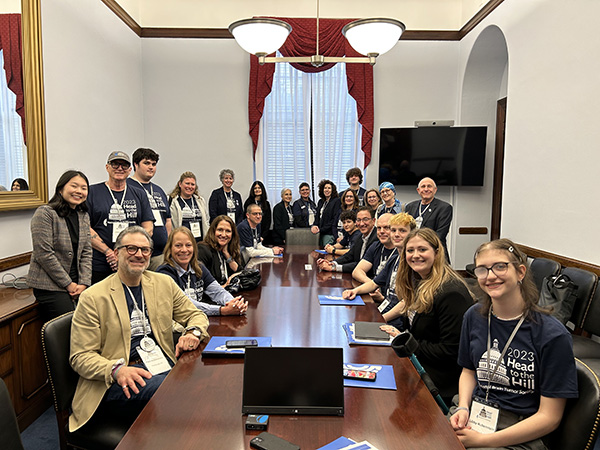
In 2023, the Rubenstein family traveled to Washington, D.C., for their first in-person Head to the Hill, where they joined brain tumor advocates from across the country to urge their members of Congress to fund brain tumor research and patient-first policies.
“Libby was very nervous about going because none of us knew what to expect,” Paul said. “Once there, she was so comfortable because she realized she found her people.”
Their advocacy has already yielded tangible results. Two of the pediatric bills the family discussed with their members of Congress during the virtual Advocate From Your State® event in fall 2025 — the Give Kids a Chance Act and the Accelerating Kids’ Access to Care Act — successfully passed in early 2026.
These achievements prove that Congressional offices are listening, but there is still much work to do. Their family is now channeling that momentum into the BRAIN Act. After the staff of Representative Summer L. Lee met with the Rubenstein family last fall, Rep. Lee officially signed on to co-sponsor the bill.
“I wrote her a note thanking her because that’s what we need,” Paul said. “We need members of Congress to champion this bill by co-sponsoring it and seeing it through the legislative process toward passage.”
Uncovering the Brain Tumor
The motivation the Rubenstein family feels today is rooted in the life-altering events of August 2020. What began as lightheadedness and vertigo — initially attributed to low blood sugar — led to other symptoms.
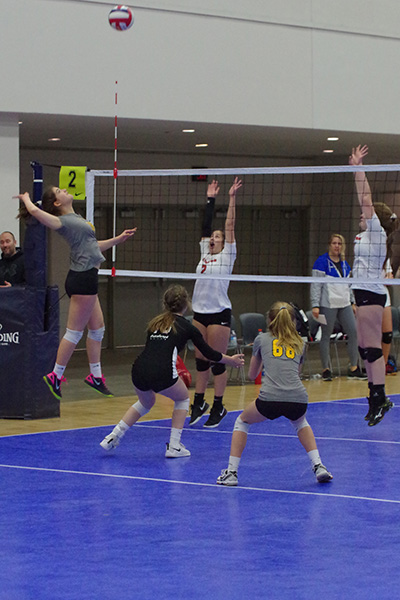
“A month or two before she was diagnosed, Libby joined a few girls from her volleyball club to do some preseason training,” Paul said. “She couldn’t stay because she couldn’t track the ball, but we thought she was just out of practice. It wasn’t until we were on vacation, and she got really dizzy walking down the steps, that we realized she needed to see a doctor.”
Libby’s optometrist observed nystagmus — uncontrollable back-and-forth eye movements — during the exam and encouraged her family to take her to the hospital. An initial scan led to a full brain-and-spine MRI that revealed a tumor the day after her 16th birthday.
“I still have a video of Libby talking to her friends right before the surgery,” Paul said. “We had no idea what was going to happen. Looking at it now, it’s even sadder because that’s the last time things were normal. She was having a very normal conversation with her friends, and none of us knew what our lives would be like after that surgery.”
Following surgery, Libby’s health care team sent the tumor tissue off to pathology for biomarker testing. Doctors ultimately diagnosed her with medulloblastoma, the most common malignant brain tumor in children, in the standard (or average) risk group. Biomarker testing determined the tumor subgroup was Group 4 (non-WNT/non-SHH), which makes up about 35% of medulloblastoma cases, according to St. Jude Children’s Research Hospital.
Posterior Fossa Syndrome
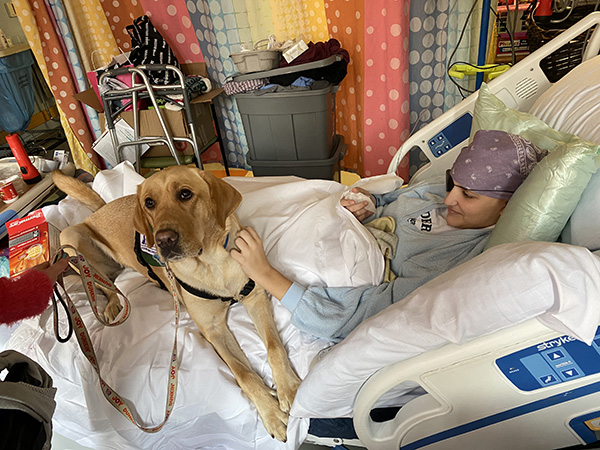
While recovering from surgery in the hospital, Libby began experiencing symptoms of posterior fossa syndrome, which can also be called cerebellar mutism syndrome (CMS).
“After the surgery, she was fine and talking, and then there was a slow progression where she could not talk, walk, or raise her hand,” Paul said. “She was having trouble swallowing, and that poor girl could not communicate.”
Typically, symptoms of posterior fossa syndrome begin within one to three days after surgery in the posterior fossa, the lower back portion of the brain. According to St. Jude Children’s Research Hospital, “about 25% of children who have surgery to remove medulloblastoma will develop posterior fossa syndrome.”
In the early days after surgery, Libby and her family had to pivot to find ways to communicate. At first, she couldn’t write on an iPad. Thanks to a family acquaintance who was a speech therapist, they used a book with tabs so Libby could turn to a page and point to the food or object she wanted. They also relied on thumbs-up or thumbs-down hand motions.
“She could not tell us how she was feeling,” Paul said. “She couldn’t explain to us what was going through her head, and that was just so heartbreaking to us.”
Navigating School and Treatment
From seven weeks of proton radiation during the COVID-19 pandemic to six rounds of chemotherapy during her junior year of high school, Libby’s path was grueling. Yet, her determination remained constant.
“She was trying to stay up on her homebound studies, where they assigned a teacher, and she took classes outside of school,” Paul said. “She was taking these classes while also going to occupational therapy, physical therapy, and speech.”
Libby studied throughout the summer between her junior and senior years and worked hard to catch up to where she would have been in school without a diagnosis.
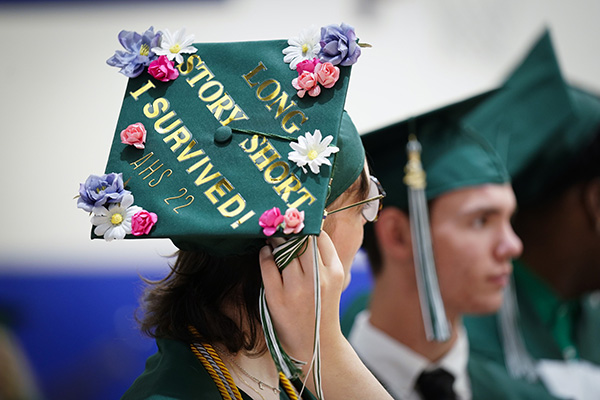
Personally inspired by a conversation with Ryan Shazier, a former Pittsburgh Steeler who suffered a severe spinal injury and relearned to walk, Libby was determined to walk across the graduation stage without her wheelchair to receive her diploma.
She did exactly that.
“We were stunned by how far she had come,” Paul said. “I was in awe of her, and I still am because of what she continues to do.”
A Voice for the Community
Today, Libby is a junior at Chatham University, living on her own and building her independence. While she continues to be monitored for secondary cancers and navigates the daily effects of posterior fossa syndrome, Libby and her family remain committed to the larger mission.
By advocating for the BRAIN Act, they are working to ensure that the next family to receive a diagnosis has access to better treatments, more funding, and a health care system designed to support them for a lifetime.
Register to Attend Head to the Hill
Be a voice for the brain tumor community in your state!
This May 3-5, 2026, join brain tumor advocates like the Rubenstein family from across the country for the 16th annual Head to the Hill in Washington, D.C., to meet with members of Congress, share your story, and push for critical investments in research and policies that support patients and caregivers.
Anyone impacted by a brain tumor is welcome. No previous experience is needed, and you won’t be alone. Our NBTS staff and seasoned advocates will provide both training and support.
Register today to attend Head to the Hill, where personal stories spark real change.
Urge Congress to co-sponsor the BRAIN Act, strengthen funding for brain tumor research, and protect merit-based research. Act today because patients with pediatric brain tumors deserve more — more and better treatment options, more hope, and more time.