This website uses cookies that help the website function and that help us understand how you interact with it. Please read our privacy policy for more information.
Three years ago, I thought I was dealing with a bad migraine.
I had dealt with headaches before. I assumed this was another episode that would pass with rest and medication. Instead, that migraine became the doorway to a diagnosis that split my life into two chapters: before and after a brain tumor.
Hearing the words “brain tumor” felt surreal. It was as if the room shrank and the future I imagined for myself suddenly blurred. In that moment, fear wasn’t abstract — it was immediate and physical. I wasn’t just thinking about surgery or treatment. I was thinking about identity. Who would I be on the other side of this?
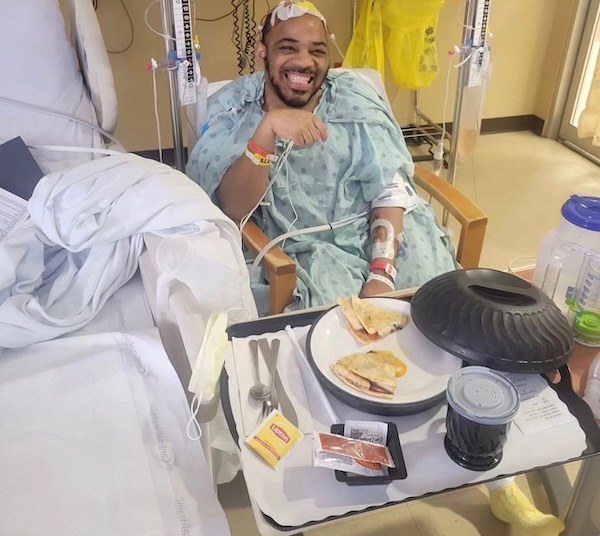
Surgery came with its own kind of courage. There is a strange quiet that settles in when you realize your life depends on strangers in scrubs and bright lights. I trusted my medical team, but trust doesn’t erase fear. It simply gives you something to hold on to as you walk through it.
Recovery was not the triumphant finish line I once imagined. It was messy, uneven, and deeply personal. I struggled with memory lapses that made ordinary tasks feel foreign. Conversations slipped through my fingers. Confidence, something I had always taken for granted, felt fragile. There were days when I didn’t recognize the version of myself staring back in the mirror.
What surprised me most was how invisible much of recovery felt. From the outside, survival can look like success. But inside, I was rebuilding piece by piece. I had to relearn patience with my body and compassion for my limits. I learned that healing is not a straight line; it’s a series of small negotiations between what was and what is.
There were moments of anger and grief. I mourned the ease of my former life. I worried about the future in ways I never had before. But alongside those emotions, something else began to grow: resilience. Not the loud, dramatic kind you see in movies, but a quieter strength that shows up in everyday persistence — getting out of bed, showing up to appointments, and trying again after setbacks.
Through this journey, I became more aware of the power of community and advocacy. Connecting with other survivors reminded me that I was not alone. Each story I heard carried echoes of my own fears and hopes. These conversations transformed my perspective. I began to see survival not just as an individual achievement, but as a shared human experience.
I also learned how important it is to speak openly about the realities of brain tumors — not only the medical facts, but the emotional landscape that accompanies them. Patients and families deserve honest conversations about what recovery can look like. We deserve spaces where vulnerability is welcomed and questions are encouraged.
Writing became one of those spaces for me. Putting words to my experience helped me process the trauma and meaning of what I had lived through. It allowed me to step back and see not only the pain, but the growth that followed. I wrote to make sense of the chaos, but I also wrote with the hope that someone else might read my story and feel less isolated in their own.
If there is one message I would share with anyone facing a brain tumor diagnosis, it is this: survival is not defined by perfection. It is defined by persistence. There is strength in asking for help, in acknowledging fear, and in celebrating small victories. Recovery may change you, but it does not erase you. You are still there, evolving in ways you may not yet understand.
Today, I carry my experience as both a reminder of what I survived and a source of purpose. It has deepened my empathy and sharpened my appreciation for ordinary moments. It has taught me that identity is not fixed; it is something we continue to shape, even in the face of uncertainty.
I later expanded this journey in my memoir, Black Cloud, written for anyone rebuilding life after a brain tumor diagnosis. My hope is that by sharing our stories, we create a network of understanding and support that reaches far beyond any single individual.
No one chooses this path. But together, by lending our voices, we can make it less lonely.
Your Brain Tumor Awareness Month gift has an immediate impact, supporting patients, driving advocacy, and funding groundbreaking research. Right now, thanks to a challenge from the Robert Lloyd Corkin Charitable Foundation, your gift is worth even more — help us raise $200,000 during the last six days of May to unlock an additional $30,000.