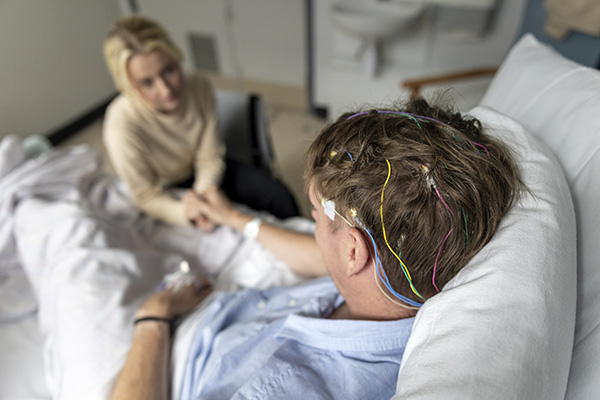
Seizures are a common symptom experienced by people living with brain tumors and may even be the reason their brain tumor was discovered in the first place.
Check out these nine tips for managing seizures from fellow members of the brain tumor community.
1. Monitor your seizures and medication side effects
Track when your seizures happen, how long they last, and any possible triggers. You’ll also want to monitor how you’re feeling while taking anti-seizure medication. You can then share this information with your care team to help them know when to adjust doses or explore other options.
“Pay attention to what you’re feeling after you start a medication and don’t be afraid to ask for something else because everyone responds differently,” said Lora A., who experienced anxiety while taking Keppra after a meningioma diagnosis.
You can jot down your seizure activity in a physical notebook, use a seizure tracker sheet, turn to an app on your phone like Epsy or Epipal, or wear an Apple Watch with the first and only FDA-cleared seizure detection app called EpiWatch.
2. Learn your personal warning signs
Some patients experience “auras” — unusual smells, tastes, or sensations — before a seizure. Recognizing these early cues can help you move to a safe place, alert someone nearby, or even take a seizure rescue medication, if appropriate.
“Julio could tell when he’s going to have a seizure,” said Liz P., whose husband had anaplastic ependymoma. “He would have tingling in his right hand, then it would move to his face, and then his speech would start changing. He’ll tell me he’s going to have a seizure, and I’ll give him his Ativan to take.”
3. Be mindful of potential triggers
Fatigue, stress, dehydration, heat, and alcohol consumption are some of the common triggers that can bring on a seizure.
“Sleep deprivation absolutely increases the risk of seizures,” said UT Southwestern Medical Center neurosurgeon Toral Patel, MD. “Alcohol and periods of stress increase the risk of seizures, as well. Those are the points I focus on when I’m counseling my patients. I tell them, ‘We’re all human, and you can’t be perfect, but as much as you can, try to limit your stress. If you can de-stress through yoga, meditation, or exercise, do that. Then, try to get a good night’s sleep. And if you’re a brain tumor patient, avoid alcohol in excess.’”
As you go about your day, be mindful of potential triggers and take steps to mitigate them.
“My seizures are very sparse now because I can feel them coming on, especially if I get dehydrated,” said Corinne C., who has oligodendroglioma. “As soon as I feel that coming on, I rehydrate and get myself out of whatever situation is causing it to build up so I can get myself back on track.”
Getting 7-9 hours of quality sleep can reduce your fatigue and help prevent seizures.
4. Explore ways to reduce medication costs
The cost of anti-seizure medications can quickly add up. Many pharmaceutical companies offer patient assistance programs, such as co-pay assistance, to help.
“Seizure medication is expensive,” said Kim M., whose husband was diagnosed with oligodendroglioma. “The second medication we were put on is very expensive. It was $925 a month. If you know to go for co-pay assistance, it’s $20 a month. Nobody advertises that if you go to this website, you can, regardless of income, qualify for this, so education about those kinds of things is needed.”
Research whether the pharmaceutical company that makes your medication(s) offers a co-pay assistance or patient support program. Many organizations have dedicated helplines and online resources to help patients access financial relief. If you’re not able to find anything, try talking to your social worker for guidance.
“We received a $6,000 bill for one month of seizure medications,” said Katie M., whose husband was diagnosed with glioblastoma. “I started to ask questions to see how to not pay for this out-of-pocket expense right away. I talked to the social worker in the epilepsy department at our local hospital. We’re actually on a payment plan through the drug company now.”
5. Be consistent when taking your medications
Follow your prescription’s instructions, including taking your medication at the same time every day. Setting alarms on your phone and pairing doses with daily routines, like brushing your teeth, can help ensure you take your medication when you should.
“I’m really religious about taking my medications,” said Josh B., who has grade 3 oligodendroglioma. “I have alarms on my phone, so I don’t miss a dose.”
Physical items can also serve as reminders. “I have my little pill box so I know when I have or haven’t taken my medicine,” Corinne said. “At first, I would put my pill box away, but that’s not helpful. I leave it out so that I see it when I’m rushing around in the morning.”
An app like MediSafe can help you track your meds. Not only can your meds be added to the app, but you can keep track of medications for anyone else in your home — pets included – to make it one less thing to remember. If you live alone, their Medfriend feature can ping a friend when you miss a dose, so someone else can check on you to make sure you take your anti-seizure medication. The app will also notify you when it’s time to request a refill.
Make sure you do not stop your anti-seizure medication without speaking to your care team first, as there can be serious consequences to abruptly stopping your medication. Your doctor can recommend an appropriate schedule to reduce the dose over time, should you need to stop or switch to a different medication.
6. Carry medication with you
“I always have an extra set of medicine just in case I forget one,” Corinne said. “I have it in my backpack or my purse. Wherever I am, I always have an extra one. Sometimes you’re in a hurry in the morning and forget to take it, or you have to work later than expected, so I’m glad to have an extra on me. And if I do use an extra, there are days when I will then go straight home to replace the extra.”
If your provider has prescribed a seizure rescue medication for you to have on hand, make sure to carry it with you to immediately address a breakthrough seizure. These medications are fast-acting, absorbed by the body in seconds or minutes to stop seizures.
7. Wear a medical alert bracelet
A medical alert bracelet that lists your condition and emergency contact information can make a difference if you have a seizure in public. Some phones have the option to add a medical ID, which can include medical conditions, allergies, and your emergency contact.
“I have a med bracelet,” Corinne said. “It just says epilepsy and brain cancer, along with an emergency number in case something happens. If I can’t explain what’s happening because I’m having a seizure, I can at least try to show my bracelet.”
8. Let others know how to help
Create a seizure action plan and share clear instructions with family, coworkers, and friends — anyone you spend a lot of time with — about what to do and not to do in the event of a seizure, including whether to call 9-1-1. If your child is the one experiencing seizures, make sure their childcare or school also knows what to do and has rescue medication if appropriate.
Friends and family can also help you in other ways. Unable to drive right now? You can use a care coordination app to set up tasks that request transportation to appointments or errands, such as grocery shopping.
And when someone offers to help, consider accepting.
“As great as it is to be independent and figure stuff out on your own, when you’re first diagnosed, if you have access to that nurse that comes by, just take it,” Corinne suggests. “Because when you’re first diagnosed, you’re so tired anyway, accept the help and take the rest while you can.”
9. Find support
Many patients with seizures describe feeling socially isolated, anxious, or depressed. Counseling or connecting with other survivors in support groups like the National Brain Tumor Society’s Brain Tumor Support Conversations can help you feel less alone.