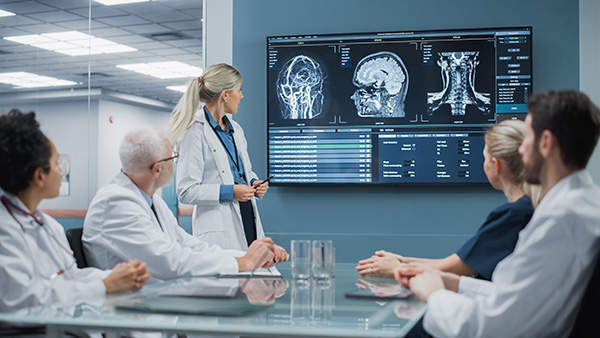
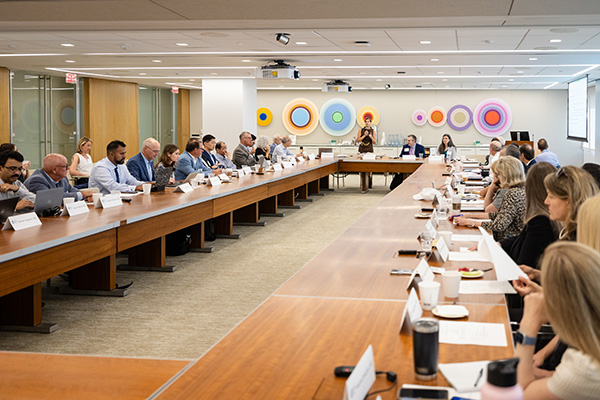
When a brain tumor diagnosis is complex or unclear, providers often bring it to a tumor board, a multidisciplinary meeting where experts come together to review a patient’s case and recommend the best next steps.
“The treatment of brain tumors is complicated,” said John de Groot, MD, Neuro-oncology Division Chief at the University of California, San Francisco. “Most institutions have a multidisciplinary tumor board where all members of the team come together to talk about a specific patient’s case.”
Who attends a brain tumor board?
A tumor board brings together specialists with expertise in neuro-oncology from within the patient’s health institution, including:
- Neuro-oncologists
- Neurosurgeons
- Radiation oncologists
- Pathologists or neuropathologists
- Neuroradiologists
Depending on the diagnosis or institution, other experts may also participate, such as clinical researchers, palliative care specialists, social workers, neuropsychologists, and geneticists.
Keith Ligon, MD, PhD — the Chief of Neuropathology at Brigham and Women’s Hospital and Dana-Farber Cancer Institute (DFCI), and the Director of the Center for Patient Derived Models at DFCI — explains why neuropathologists participate in the tumor board.
“The data that we deal with and work to help analyze for the patient comes from the tissue, so we’re the team members that are actually examining the cells and tissue that comes out from a surgery, for instance, or from their blood or cerebrospinal fluid (CSF),” Dr. Ligon said. “We’re the main and unique member of the tumor board team responsible for making the diagnosis and then discussing with the teams how it can be integrated with data from imaging of the tumor by MRI and other methods. This gives a complete picture of what is the best approach for treatment decisions.”
Because patients do not attend tumor board meetings, it’s important that they share their quality-of-life concerns, goals, and priorities with their care team ahead of time. After the meeting, the clinician who knows the patient best — usually the neurosurgeon or neuro-oncologist — will explain the recommendations to the patient.
What do they discuss in a brain tumor board?
Diagnoses that benefit from group discussion are presented to the tumor board.
Typically, the neuro-oncologist or neurosurgeon familiar with the patient will introduce the case. Radiology and pathology experts then review imaging scans, tissue findings, and biomarker testing results. From there, the group discusses potential treatment options based on collective expertise.
Here are a few examples of when a case might be brought to a tumor board:
Example #1: Newly Diagnosed Patient Before Surgery
Before surgery, a tumor board may help determine:
- Whether surgery is recommended now or if “watch and wait” is appropriate
- Treatment options if surgery is not possible
- The safest or most effective surgical approach
- Risks related to tumor location or patient factors
- Whether there are appropriate clinical trial opportunities to consider before or after surgery
Example #2: Newly Diagnosed Patient After Surgery
After surgery, the tumor board often reviews pathology and biomarker testing results to guide next steps.
“My husband’s neurosurgeon showed the before-and-after imaging, which got a standing ovation in the UCSF tumor board because [the neurosurgeon] achieved a full resection of a lemon-sized tumor,” said Katie N., whose husband was diagnosed with grade 2 oligodendroglioma. “The board discussed options and recommended no further treatment at this time, just regular scans.”
In some cases, the tumor may be rare and lack a standard of care.
“Our neuro-oncologist, who was the head of the Mayo Clinic Neuro-oncology program, had never even seen my husband’s tumor before,” said Jenny B., whose husband was diagnosed with a rare brain tumor. “He brought it to the tumor board for discussion. They determined that because the biomarker testing indicated an aggressive component, they recommended to go ahead with radiation and chemo.”
Example #3: Possible Tumor Progression
Tumor boards are also used when follow-up scans show changes that are hard to interpret. Sometimes a new spot on imaging could be:
- Tumor progression
- Radiation necrosis
- Scar tissue
- Treatment effect
“I got a call from the doctor’s office saying, ‘Oh, there’s a spot that we’re looking at. It could be progression, or it could be like scar tissue, so we’re going to present it to the tumor board,'” said Tosha B., who was first diagnosed with a brain tumor in 2018. “The board agreed that it was tumor progression. Because my tumor was unmethylated, wild-type, and had the H3K27M mutation, they recommended a clinical trial that they thought would be really good for me.”
Example #4: Clinical Trial Opportunities
A patient case may be presented to discuss the clinical trial options available to them, which is why some tumor boards include members of the clinical research team.
“We talk about clinical trial opportunities for those patients,” Dr. de Groot said. “We determine if there is a trial where they might need to have a surgery done, so we can identify the patient who might need to receive a therapy before they go to surgery.”
Tosha enrolled in a clinical trial recommended by the tumor board and has been stable taking the medication since 2019. In fact, the FDA granted accelerated approval for dordaviprone (Modeyso), formerly called ONC201, in 2025.
Did you know? National Brain Tumor Society funding helped advance foundational research for this drug, and directly supported development work on ONC201 through a grant to the drug’s previous developer.
Why is collaboration important?
Tumor boards allow all specialists involved in a patient’s care to share insights simultaneously.
Whether the group of colleagues agrees with the presenter’s initial recommendation or engages in a collaborative discussion that leads to a different recommendation, the patient benefits from their collective expertise.
“I think the benefit to the patient, in particular a patient whose case is being presented to the tumor board, is to have all the people involved in that patient’s care to be in the same room at the same time,” Dr. de Groot said. “It’s probably the only way to have that kind of conversation and come to what we think is the best treatment decision for an individual patient.”
For many patients, knowing their case has been reviewed by multiple experts can offer reassurance that they’re making informed decisions about their care.
“Knowing my case was being presented in front of a tumor board honestly made me feel better because instead of one person’s judgment guiding my care, it’s going to be multiple experts in the area,” Tosha said.
Do I have to follow the brain tumor board’s recommendation?
No. A tumor board’s recommendation is not a mandate; it’s expert guidance meant to help the patient make informed decisions.
The final decision about care is made between the patient and their doctor, taking into account personal values and quality-of-life goals. Tumor board recommendations do not overwrite a patient’s preferences.
Should I ask my care team about brain tumor boards?
National Brain Tumor Society encourages patients to seek second opinions before receiving care, when it’s safe to do so. As part of this process, patients and caregivers can ask:
- Does your institution have a tumor board that meets regularly?
- Will my case be presented at that tumor board?
“This may seem like a lot for a patient or a family member to be asking a neurosurgeon all these questions about their expertise, but I can tell you that any true specialists that’s worth their salt have no problem with them because they have ready answers to those questions,” said Edjah Nduom, MD, neurosurgeon at Emory University and former NBTS board chair.
If the health institution does not have a dedicated brain tumor board, seeking a second opinion at a specialized center may be an important next step. Unsure of where to find a second opinion? NBTS’s Personalized Support & Navigation team can answer questions about tumor boards, second opinions, and clinical trials.