This website uses cookies that help the website function and that help us understand how you interact with it. Please read our privacy policy for more information.
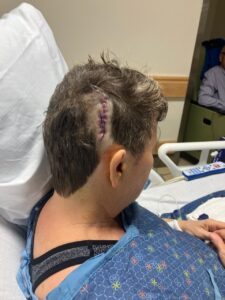
Matt D. was in a routine work meeting when his words stopped matching his thoughts. Key words were left out entirely. Thinking it was just an off day, he tried writing an email instead, only to realize with growing frustration that he couldn’t make sense of the text on the screen. Matt wasn’t having an off day. Due to a not-yet-diagnosed brain tumor, Matt was experiencing the sudden onset of aphasia, a language disorder that can affect a person’s ability to speak, write, or understand.
According to the ASHA Leader, an estimated 30% to 50% of people living with brain tumors experience aphasia. It can develop gradually as a tumor grows, emerge as a side effect of radiation, or appear suddenly after surgery.
Jodi Morgan, MS, CCC-SLP
Yet, despite how common it is, many families don’t know the name for what their loved one is experiencing.
“A lot of times, people will come home from a major surgery like getting a brain tumor out, and they won’t even know the word aphasia,” said Jodi Morgan, MS, CCC-SLP, co-founder of the Brooks Rehabilitation Aphasia Center. “Many patients will come to me and say that their doctor never told them that the reason they can’t talk is called aphasia.”
Let’s talk about aphasia caused by a brain tumor, common symptoms, tips for communication, and how to find support.
What is aphasia?
Aphasia is a language disorder that impacts how someone can communicate, typically caused by damage to the areas in the brain responsible for language.
“All people with aphasia have problems getting their words out,” Jodi said. “They know what they want to say, and they can’t get it out. Sometimes people have reading or writing problems, trouble understanding, but it depends on what type of aphasia they have.”
Because aphasia is a language disorder, it does not impact someone’s intelligence or life experiences. Instead, it acts as a barrier between their thoughts and their ability to communicate them.
“I tell people that your intelligence is the same,” Jodi said. “But aphasia is like being dropped in another country, and you don’t know the language. You’re still as smart as you ever were, and you still have all of your life experiences, but all of a sudden, you can’t read the menu or understand what people are saying. When you go to talk, you can’t get out what you want to say.”
Cognition or memory challenges can co-occur with aphasia due to a brain tumor, but aphasia does not affect one’s intelligence.
What are common challenges for people with aphasia?
Depending on the specific area of the brain impacted, aphasia can disrupt someone’s ability to communicate in different ways.
Speaking: Patients may struggle to find the right words, substitute incorrect words, or speak in short phrases.
Comprehending: People with aphasia may have difficulty understanding what other people are saying, especially in fast-paced conversations or group settings.
Reading: Patients may experience trouble decoding written words and understanding what they just read.
Writing: People with aphasia may have difficulty forming letters, spelling words correctly, or putting sentences together, so their sentences may not make sense.
“Aphasia for me is struggling to find words when I am speaking, mostly,” said Annie M., who has meningioma. “I can be smack dab in the middle of a conversation, know exactly what I want to say, but the words just don’t come out. When it happens, I immediately get embarrassed, and I find that I start talking with my hands, stop eye contact, and pause longer than normal. The words will come eventually, but it does take time now since my surgery — even seven years post-op.”
For Dan and his wife Jeanne H., his neurosurgeon operated on the part of the brain responsible for speech and language to resect his glioblastoma tumor, so the couple knew that he might have some challenges once he woke up.
“The change was immediate after surgery, but it got worse,” Jeanne said. “Dan took it in stride, but it just made it more difficult. If he had trouble communicating with me and I didn’t understand it, he would cry. He couldn’t perform his job as a psychotherapist and had to change his life. He stopped being able to read, which he loved to do.”
What are the different types of tumor-related aphasia?
Because different parts of the brain control different aspects of language, a tumor’s specific location indicates the communication challenges a person may face.
Generally, tumor-related aphasia can be categorized as either non-fluent or fluent.
Non-fluent Aphasia
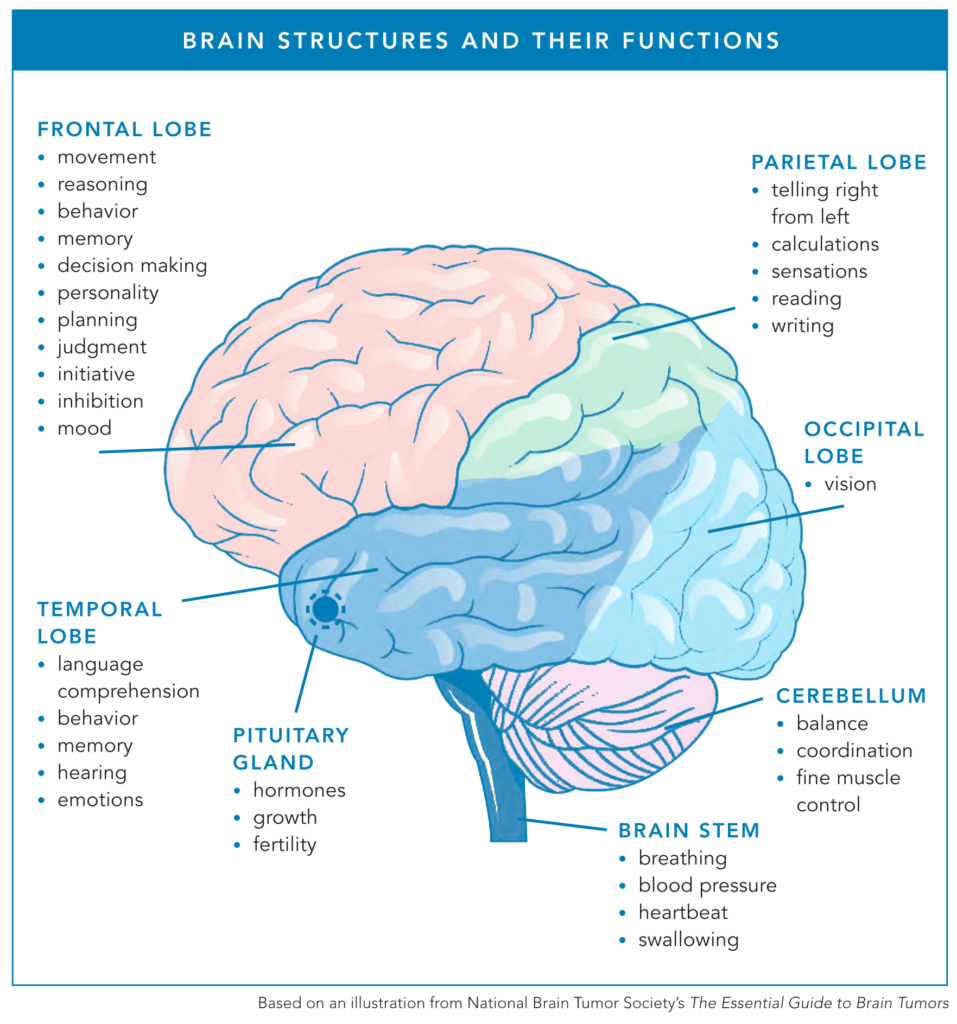
When a tumor is located in the anterior (front) portion of the brain, it impacts the areas responsible for the physical and mental output of language.
“Patients with anterior brain tumors tend to have more expressive problems because your motor strip is there,” Jodi said. “They might have apraxia (a challenge with motor speech planning) in addition to aphasia, so these folks have a rough time getting their words out and might have problems with other language modalities as well.”
While they may understand what others are saying, their own speech requires great effort. A person with non-fluent aphasia needs patience and extra time to get their words out.
Types of Non-fluent Aphasia:
Broca’s aphasia is caused by damage to Broca’s area, a region located in the frontal lobe associated with articulation and speech production.
The person knows what they want to say but struggles to produce more than a few words. With Broca’s aphasia, speech is often choppy and limited to short, vital words. They will also find it hard to write.
Global aphasia is the most severe form of aphasia. It occurs when extensive damage is done to the language areas of the brain, leaving the patient with significant difficulties in both speaking and understanding language. Patients with this type of aphasia are not able to read or write.
Similar to patients with Broca’s aphasia, these patients struggle to initiate speech on their own. However, the person can repeat words or phrases spoken to them with relative ease.
Fluent Aphasia
When a tumor is located in the posterior (back) of the brain, a person can produce speech, but the meaning of their words is compromised. A person with fluent aphasia might need others to use visual cues or gestures, as they may not fully comprehend the spoken words they are hearing.
“The auditory cortex is back there, the part of the brain that receives and processes sound, so their language comprehension is impaired,” Jodi said.
Types of Fluent Aphasia:
The person’s speech is fluent and grammatically correct, but they struggle to find the nouns and verbs they need. It might feel like the word is on the tip of their tongue. For example, they may be unable to find the word for “tree” or “car.”
Cleveland Clinic offers this example: “You may be thinking of an apple, but you can’t get the word ‘apple’ out. You might instead say, ‘the… uh… red thing that grows on trees’ or ‘the stuff you put in a pie.’”
People with conduction aphasia can understand language and speak fluently, but they are unable to repeat words or phrases even though they understand what was said to them.
Speech is fluent but lacks meaning because people with transcortical sensory aphasia don’t comprehend questions or statements, so their response may not be related to the conversation. Unlike Wernicke’s aphasia, the person can repeat words or phrases.
With Wernicke’s aphasia, patients speak fluently and with normal rhythm, but their sentences may be a “word salad” — a mix of random words and jargon — so they don’t make sense to others. They also have trouble understanding spoken language and are often unaware that their own speech isn’t making sense to others. It is also difficult for patients with this type to repeat phrases or words.
This type of aphasia is caused by damage to Wernicke’s area, located in the posterior superior temporal lobe. UCSF explains that “information is heard through an intact auditory cortex in the anterior temporal lobe; however, when it arrives at the posterior association areas, the information cannot be sufficiently translated.”
Can aphasia get better?
Yes, tumor-related aphasia can improve. If a person experiences speech difficulties before surgery, removing the tumor can alleviate pressure on the brain’s language centers and resolve symptoms.
However, it is common for communication challenges to temporarily worsen immediately after surgery. Families are often alarmed by this, but it is typically a temporary setback caused by post-operative swelling.
“There’s a lot of edema (swelling) after a brain tumor surgery, and the person might be having a lot more trouble communicating,” Jodi said. “That’s going to dissipate as they go home, and that swelling goes down on their brain.”
Aphasia caused by a brain tumor typically remains the same unless there are other medical complications, such as the tumor progressing, recurrence, or radiation necrosis. In these instances, aphasia can worsen.
The Power of Neuroplasticity and Speech & Language Therapy
With dedicated speech and language therapy, aphasia symptoms may improve.
Speech-language pathologists (SLPs) use targeted exercises to help patients rebuild vocabulary, practice speech mechanics, and find alternative ways to express themselves.
“There’s research showing so many people recover long, long, long after their brain tumor or stroke because of neuroplasticity (the brain’s ability to rewire itself),” Jodi said.
A Quick Note on Primary Progressive Aphasia
Because aphasia has been in the news in recent years, it’s important to understand that tumor-related aphasia is different from primary progressive aphasia.
Primary progressive aphasia is a language disorder that is caused by a progressive neurologic disorder under the umbrella of dementia. It is not caused by a brain tumor. This type of aphasia will get progressively worse over time.
“When Bruce Willis announced his diagnosis years ago, they said he had aphasia and had difficulty memorizing his lines,” Jodi said. “Bruce has primary progressive aphasia, which is different from aphasia caused by a brain tumor or a stroke. People worry that their memory or cognition will be totally wiped out, which is not always true.”
How can people better communicate with a person with aphasia?
Navigating aphasia requires patience, adaptation, and a shift in approaching conversations. The goal is to keep the individual connected to their life and the people around them.
“Make sure you establish a communication system so they can be part of life’s conversations and medical decisions,” Jodi said.
Endrian B., who has a pituitary tumor, said, “One thing I’ve learned with having aphasia is that if I stick to a regimen and use sticky notes, dry-erase boards, and people around me who understand my new normal, it gets a little better as time goes on.”
Give people extra time to process what you’ve said and to find their words without rushing them.
“My brain can’t really keep up with conversations or something that’s new very well,” said Matt D., who has been living with oligodendroglioma since 2014. “I have to slow down my own thoughts, and it requires someone else to try to slow down as well so we can be on the same page.”
They don’t need you to talk louder — just slower.
“It is not that we don’t care about you or your stories,” said Ashley B., who has meningioma. “It really is that sometimes we just can’t get our brain caught up fast enough to continue conversations at the pace it has been going.”
Visual aids take the pressure off auditory processing and verbal speech mechanics. These tools can include pictures, whiteboards, sticky notes, and more.
Implement a whiteboard. “I use whiteboards all the time,” Jodi said. “We do what’s called keywording, which is like writing closed captions on a whiteboard to help somebody who has aphasia. If you’re watching a foreign film or a movie where someone talks too fast, closed captions help all of our brains. We can write the main words of a conversation on a whiteboard to help them understand the gist of a conversation.”
Utilize a yes/no board. This tool allows patients to point to clear options, empowering them to be a part of the conversation. As Jodi explains, they can point to the tool and say, “Yes, I want this surgery, or no, I don’t. Yes, I’m OK with you increasing my medicine, or no, I’m not.”
Show pictures. Pull up a photo on a phone to show the person what you’re talking about. ParticiPics has a free database of pictographic images to help people communicate with loved ones with aphasia.
Reference sticky notes. Label things around the person’s home with sticky notes to help with word-finding, or use a sticky note to cover up a large amount of text to make it easier for the person to process what they’re reading.
Open-ended questions (e.g., “What do you want for dinner?”) can cause a mental logjam. Structuring questions can make a big difference.
Offer specific choices. Instead of asking an open-ended question, narrow the field. For example, write down the word “restaurant” or “dinner,” and then list three specific restaurant options you know they like. These choices empower them to understand the message and make a definitive choice. Showing a photo of each restaurant can also help.
Verify comprehension. Patti G., whose husband has astrocytoma, emphasizes the importance of checking in: “He wants to be included in conversations. I will check often that he understands what is requested of him because most people don’t understand how to ask yes/no questions and confirm understanding.”
Watch for nonverbal cues. Pay close attention to facial expressions to gauge if a message was received. Jodi notes, “If I asked you what your occupation was and you looked at me blankly, I would know right away that you have no idea what I’m talking about. I can then try to rephrase it quickly, using the words ‘job’ or ‘work’ instead.”
Using gestures helps people with aphasia because it bypasses the brain’s damaged language centers, instead relying on intact visual and spatial networks to process meaning. These physical movements give the brain extra time to connect what they are seeing with the spoken words they are hearing.
Invite the person with aphasia to answer your question with a thumbs up or down to simplify the conversation.
When words fail, look to other creative ways to communicate, such as drawing or painting.
Ask them to draw a picture. If words won’t come, hand them a pen or a smartphone drawing app. Jodi recalls this example:“I had a gentleman after surgery who was so upset about something, but his wife and family couldn’t figure it out. I asked him to draw a picture, and he drew a picture of a stick dog. All of a sudden, the family asked if he was worried about their dog. He wanted to know about the dog and FaceTime with the dog to see if he was OK. He couldn’t say the word dog, but he could draw a dog.”
Turn to art. Creative outlets can offer patients a way to express their voice other than speaking. Amy Van Cleve, Art for Recovery Program Director at the University of California, San Francisco (UCSF), shares, “We had a patient a few years back who got a brain tumor. Pre-cancer, she was a public speaker. She was an author. With where the tumor was on her brain, she lost the ability to speak. That element was so traumatic for her. Our program became the only space that she could show up. She didn’t have to talk. She let her painting talk. She couldn’t write these long speeches anymore, but she could write a few words. She could reclaim her voice in a way, and that was really profound.”
Patience is an important tool in a caregiver’s toolkit, and it goes two ways: giving your loved one ample time to form their thoughts and reframing how you view interruptions.
Because word retrieval requires immense effort, a person with aphasia might talk over you or interrupt your train of thought. Rather than viewing this as rudeness or a lack of listening, recognize it as a coping mechanism for a fading thought.
“Words don’t come to me as easily even if I know them,” said Kat J., who was diagnosed with astrocytoma. “I have a harder time communicating in general. I feel like I forget things as soon as I want to say them, which adds an urgency to my participation in conversation. That urgency sometimes comes across as not listening to other people or cutting them off, but really I’m just afraid that I’m going to forget what I wanted to say.”
How can people with aphasia communicate better?
Navigating aphasia requires patience, adaptation, and a shift in approaching conversations. The goal is to keep the individual connected to their life and the people around them.
“Make sure you establish a communication system so they can be part of life’s conversations and medical decisions,” Jodi said.
Endrian B., who has a pituitary tumor, said, “One thing I’ve learned with having aphasia is that if I stick to a regimen and use sticky notes, dry-erase boards, and people around me who understand my new normal, it gets a little better as time goes on.”
When a person hits a mental block and a specific word feels completely trapped, they should avoid exhausting their energy trying to force that exact word out. Instead, they can describe the concept, purpose, or attributes of the item (circumlocution).
“Aphasia feels like trying to navigate a boat in a river that’s moving just a little bit too fast,” Kat said. “The idea is there, the concept is there, but it’s flown away just a little too fast for you to catch it. Try describing what the word does instead of trying to remember the word. If you cannot remember the word ‘train,’ try to describe it like ‘the large vehicle on rails that goes choo choo.’ It might feel frustrating and dumbed down, but the faster you can make your point, the happier you will feel.”
Modern technology can offer helpful workarounds for reading, typing, and word retrieval.
Turn on closed captions when watching anything on a device.
Ask AI for word-finding help. Laurie W., who has meningioma, suggests, “ChatGPT is a great tool to help you remember terms without having to ask other people.”
Use helpful apps. There are a variety of apps available to support people with aphasia, including specific augmentative and alternative communication (AAC) apps that allow someone to tap on pictures, icons, or pre-saved phrases that the app will then read aloud, as well as text-to-speech applications. A speech-language pathologist can recommend helpful apps based on the person’s circumstances.
Matt said, “An attempt to read exhausts my energy and brings on the headaches. To adapt, I’ve learned how to build connections with text-to-speech applications. My main tools are enabling dictation on my iPhone, NaturalReader, a notes app, and Google. That way, I can now read any text by speaking it out to me, or I can speak out any text if I’m struggling to type it out. And if I’m really struggling to get the word, Google has the best search results for what I’ve intended.”
People living with aphasia caused by brain tumors often find that stress and fatigue can worsen their symptoms.
Save important conversations for when the person is rested. Molly M., who has grade 3 astrocytoma, said, “If I get tired or anxious, I will start losing my words.”
Limit socialization to avoid overdoing it. Kat said, “I’ve had to impose a fairly strict 2-hour time limit to socialization because I get so tired even for days afterward if I push myself too long.”
How can aphasia impact emotional or mental health?
Because an individual’s identity is deeply tied to how they express humor, thoughts, and emotions, losing that ability can take a toll on mental well-being.
“Patients who have a stroke without aphasia, statistics show about a 30% chance of depression and anxiety,” Jodi said. “When someone has aphasia after a stroke, that chance doubles to about 70%, so it is imperative that people with aphasia get some help because it affects their identity.”
Risk of Isolation
When communication becomes exhausting or unsuccessful, many individuals withdraw from social situations entirely to avoid frustration or embarrassment.
“People want to be a part of the conversation,” Jodi said. “If you keep asking them and [the person] can’t build success [in the conversation], they’re going to isolate themselves. We see that happen a lot, and mental health is really important in people with aphasia.”
Struggle to Find Support
For many people, their primary coping mechanism is to talk through it with a loved one or a therapist. For someone with aphasia, the very condition causing their distress can prevent them from vocalizing it.
“When we’re upset, we would talk to somebody,” Jodi said. “But they can’t, so it’s important to find professionals who understand aphasia and communication deficits and get services. There are different techniques counselors can use to counsel somebody who can’t talk.”
How can people with aphasia find community and support?
Connecting with professionals and peers who truly understand the daily realities of this condition can make a big difference.
“Get support and become a part of a community to talk to others with aphasia,” said Jennie S-G., who was diagnosed with meningioma and had a stroke after her craniotomy. “Get support from speech pathologists. There are a ton of organizations that support these people and make them feel heard and welcome.”
1. Work with a Speech-language Pathologist
A speech-language pathologist works closely with both the patient and caregiver to design personalized communication strategies, introduce assistive technology, and maximize daily independence.
The National Aphasia Association offers an online directory to help people find a qualified provider or an aphasia clinic near them.
2. Join a Brain Tumor Support Group
Because tumor-related aphasia comes with the added layers of treatments, surgeries, and scans, connecting with fellow brain tumor survivors can provide comfort and support.
“Seek a support group,” Endrian said. “There are people living with aphasia and groups that help you come up with ways to cope with your diagnosis.”
The National Brain Tumor Society hosts a monthly virtual support group for patients, called Brain Tumor Support Conversations, and one for care partners, called Caregiver Support Conversations. Connect with community members who understand the unique experience of living with a brain tumor, including many attendees who are also navigating aphasia.
3. Connect with Aphasia-specific Communities
Finding peers who are specifically facing language barriers can help remove the pressure of keeping up with fast-paced conversations.
Aphasia-specific organizations like Aphasia Recovery Connection and regional aphasia centers offer ways to virtually meet with other people living with aphasia. Keep in mind that in these broader groups, many participants may be recovering from a stroke or traumatic brain injury rather than a tumor, but the shared language barriers can be a supportive point of connection. To find one nearby, search for your “city/location” + “aphasia support group.”
“A lot of organizations, like Brooks, offer free groups online [for their patients and the greater aphasia community],” Jodi said. “We have a group conversation that’s led by a mental health counselor.”
Patient & Caregiver Toolkit
Patients and caregivers are our top priority.
We equip patients and their care partners with the tools and resources they need to navigate every step of their unique health care journey — from understanding their diagnosis and building their medical team to making treatment decisions, including accessing clinical trials and palliative care.
Empower yourself with the resources and support you need throughout your brain tumor experience by browsing through our patient and caregiver toolkit.