This website uses cookies that help the website function and that help us understand how you interact with it. Please read our privacy policy for more information.
My husband, Ed, was a talented radio producer and communications professor, an involved community member, and a beloved husband and father. He had a vibrant personality, a great sense of humor, loved cooking, and was never without a cup of coffee. At the end of July 2024, after two weeks of pressure headaches following a sinus infection, Ed drove himself to the ER after dropping our son off to head to Boy Scout summer camp. He told me not to cancel our dinner plans for the evening; that’s how far from our minds anything serious was.
Three hours later, he told me to get to the ER. They had found something. His lingering sinus infection was our worst nightmare of glioblastoma. The headaches had been his only symptom. Though we were devastated and terrified, Ed faced his diagnosis with incredible determination, strength, and humor. He kept saying, “I’m still here, I’m fighting, I’m not giving up.” He had an amazing medical team who fought right alongside him, and we were grateful.
While he did not want to be defined by his diagnosis, he found strength in sharing his story and helping others going through the same challenge. The line from the movie Clerks, “I’m not even supposed to be here today,” was something he repeated throughout his treatment.
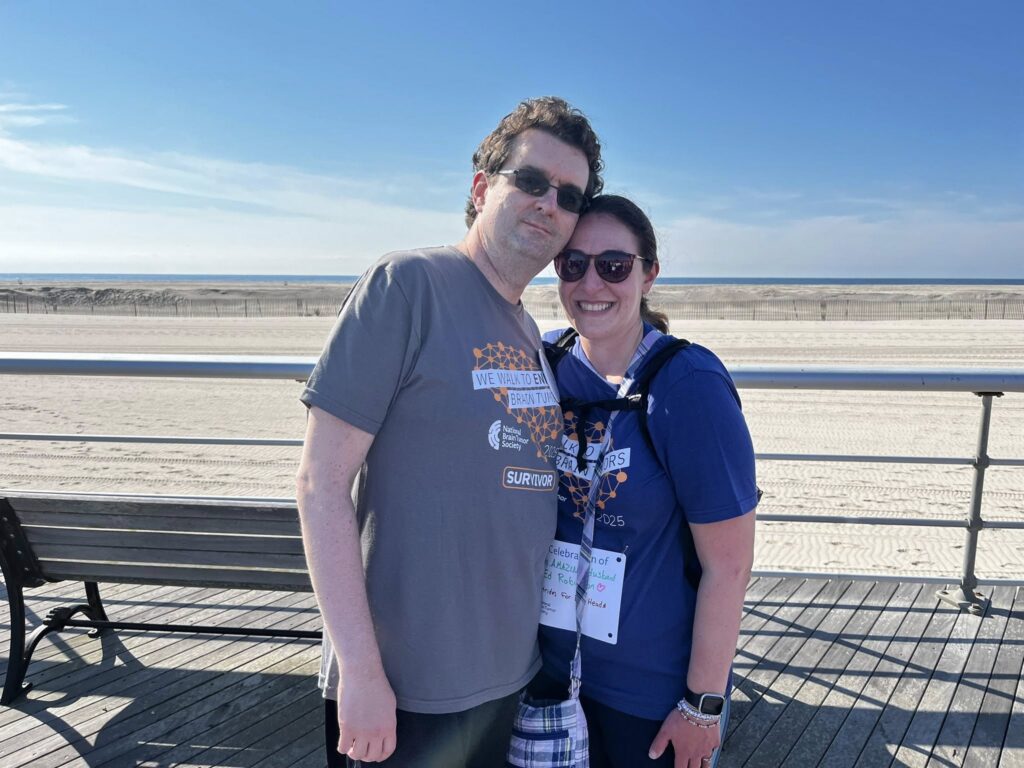
It’s what he titled an article he wrote for the National Brain Tumor Society about his experience with glioblastoma. He also wanted to do the NBTS Walk, but we were not sure if he would be able to after a setback a month earlier. We put a team together in two weeks, and he walked the entire 3+ miles. It was a measure of progress for him, and he was so proud to be able to do the walk and contribute to finding better treatments for brain tumors.
Ed passed away on October 14, 2025, 14 months and 23 days after he drove himself to the ER. I was not surprised when they told me Ed was an organ donor because he was always one to help others without hesitation. He saved the lives of three people with a donation of his liver and both kidneys.
We are picking up where he left off and starting a nonprofit in his memory called Echoes of Ed Foundation, funding scholarships for students going into communications-based majors, revamping the radio station at the university Ed worked at, and funding research toward fighting glioblastoma so no family has to endure what ours has. We will spend the rest of our lives continuing to fight on his behalf.
It was like someone took a snow globe that represented our lives and shook it. It was an instantaneous change. And it was nonstop, from the shock of there being something on his brain, to this is definitely cancer, to having to rush him back to the ER two days after his biopsy due to scary symptoms that wound up being low sodium levels, to learning it was glioblastoma, to needing a craniotomy, all within two and a half weeks. There was never time to relax or process what we had just been through before the next shake of the snow globe occurred.
We were almost immediately surrounded by support and love, not only from our friends and family, but from the community we live in, our son’s Boy Scout troop and karate studio, Ed’s work community, my work community, the list goes on and on. We could not be despondent for long because someone was always there for us, often before we even asked, and we were so grateful. The most difficult part of our journey was finding people our age going through this. It took a lot of investigating. We were always the youngest ones in every waiting room we were in, and that hit us hard.
There needs to be more focus on finding treatments for brain tumors, especially glioblastoma. I owe it to Ed to bring awareness to this beast of a disease so that others understand exactly what we went through and hopefully are inspired to help. It is also a productive way to channel our grief and trauma.
Despite all of the outpouring of support and knowing we were doing everything possible to help him, despite having two world-class hospital systems working together on his treatment plan, we still felt isolated and alone.
As a radio guy, Ed had such a vibrant personality, and we feel that not channeling that quality into our approach to fighting glioblastoma would be a disservice to his memory. Strides for Ed’s Head will continue to walk every year in the National Brain Tumor Society walk, and Echoes of Ed Foundation will shout awareness from the rooftops about this disease that stole my husband and my son’s father.