This website uses cookies that help the website function and that help us understand how you interact with it. Please read our privacy policy for more information.
Emmie came into this world as peacefully as possible. She was my buddy, and at just four years old, she had quite a community of friends. She was ever so spunky, sassy, and bubbly. She was a spitfire who loved to dance, loved Frozen, and loved playing with her sister, Annabelle. She would sing “This Girl is on Fire” from her car seat, and it was true. She was fire, but in all the right ways.
Recognizing Early Medulloblastoma Symptoms in Children
Just before Halloween, everything changed. It started as a slight runny nose and headaches, so the doctors initially suspected a sinus infection.
We were shopping at Target when she suddenly became exhausted and lethargic, resting her head on the cart. We went home; she took a nap, woke up, and vomited. But then she bounced back, dinosaur-stomping around the house in her new boots with full normal energy.
Her vomiting kept getting progressively worse. She’s getting more and more headaches, more and more lethargy, more and more needing to be close and snuggle. For a 4-year-old to be able to tell me that her head kept hurting and she needed ice, I knew something wasn’t right.
I took her to the pediatric emergency room, and they did a CT that led to an MRI. They didn’t even have to sedate her for the 15-20 minute MRI because she couldn’t move anyway. By 7 p.m. that day, they told me she had a brain tumor, and they suspected medulloblastoma. They would know for sure once a biopsy was done, and they airlifted us to Nicklaus Children’s Hospital in Miami.
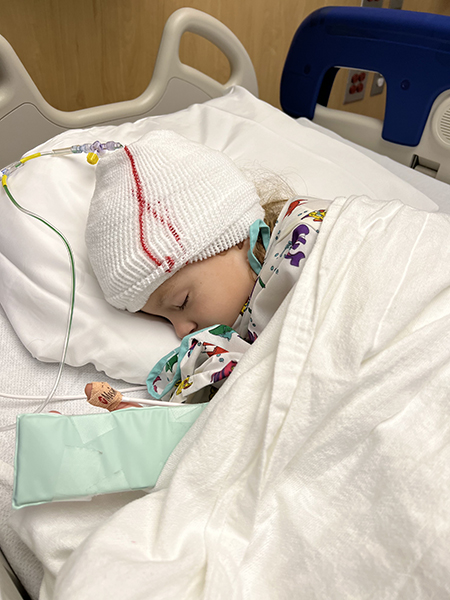
There, she got a shunt to drain excess CSF, followed by a fully sedated MRI. After reviewing the results, they didn’t want to wait to schedule surgery for later. Instead, they took her straight into emergency surgery and had a 99% resection of the tumor, which was about the size of a walnut.
They took the tumor and sent it off for pathology. The initial in-hospital testing confirmed medulloblastoma. That’s when the doctors sat us down and explained medulloblastoma: ‘In this scenario, this is the percentage of survival. This is the trait. This is the plan. This is what we want to do.’
We went to the local ER on Nov. 4. Surgery was performed the following day on Nov. 5. By Nov. 10, we were preparing to go home with a plan for chemotherapy to begin on Nov. 20.
It was later confirmed to be SHH-activated and TP53-mutant medulloblastoma with both MYCN and GLI2 amplifications, which made it an extremely aggressive brain tumor.
Why Biomarker Testing is Essential in Pediatric Brain Cancer Treatment
This is where our journey took an unusual and critical turn, highlighting exactly why biomarker testing is so important. After Emmie’s first chemo treatment, her liver levels weren’t coming down like the team wanted, and her kidney levels were spiking. While they were trying to regulate her levels, the pathology report came back with the biomarker testing results.
That’s when we learned that Emmie’s tumor had a double BRCA2 mutation, and further testing confirmed a diagnosis of Fanconi anemia (FA-D1 subgroup) — a rare genetic disorder inherited because both my husband and I were carriers. We had no idea we were carriers until after Emmie’s diagnosis. We later learned that 97% of kids with FA-D1 will be diagnosed with cancer by age 7, and it’s usually a brain tumor (often medulloblastoma), Wilms tumor, or leukemia.
That biomarker discovery forced us to change the entire plan. Because Fanconi anemia severely impairs the body’s ability to repair damaged DNA, traditional chemo would have destroyed everything in her DNA makeup.
Testing didn’t just save her from the devastating effects of the wrong treatment; it also empowered our family with vital genetic knowledge. Because of Emmie’s diagnosis, I learned I was a BRCA carrier and was able to take preventative measures, like a double mastectomy, to reduce my own cancer risk so I can be here for my family.
Navigating Recurrence, Radiation, and Hospital Life as a “Momcologist”
Despite our new plan, by Dec. 1, Emmie’s tumor had grown back and nearly filled the entire space again in less than a month. She endured a second brain surgery. We then started proton radiation. To keep life as normal as possible for her sister Annabelle, we would drive two hours to Miami in the dark for the first radiation therapy appointment of the day, returning home just in time for school pickup. She had a very reasonable quality of life while we were doing radiation.
After radiation, she started to lose mobility in her legs and ended up inpatient for one thing or another. Because of the lower extremity mobility loss, her bowels became a problem, and she lost the ability to poop on her own.
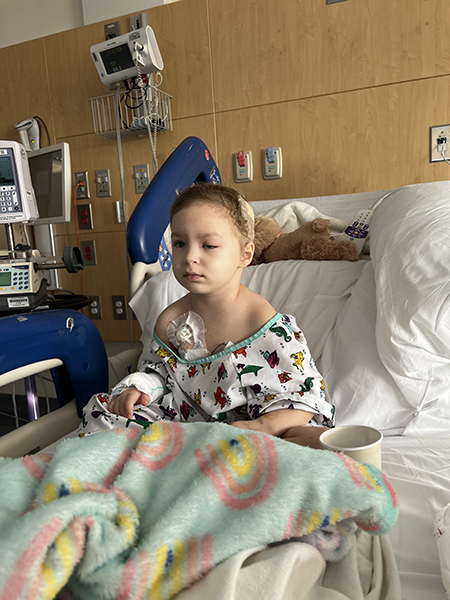
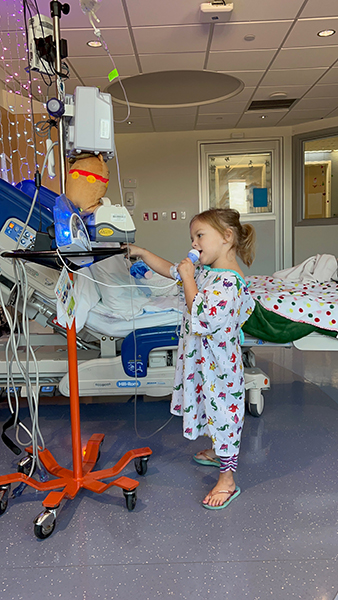
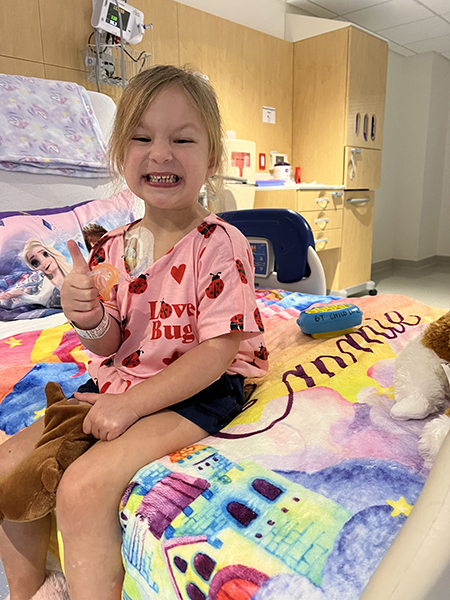
Over six months, Emmie had 17 MRIs. I became a “momcologist” and became well-versed in advocating for the best opportunities for her. I moved into the oncology tower. Because she was on steroids, she had an insatiable hunger, so I set up a mini-fridge and a Keurig in our room. You learn to work the system by ordering things the day before and putting them in the mini-fridge so Emmie could have her squiggly noodles and pasta with green parmesan cheese for breakfast.
Even in the hospital, we had fun. We made a TikTok page for her called “Emmie is Cooler Than Cancer,” where she would dance around her IV pole to “Let It Go.” You have to let them be kids, even when they are dealing with cancer.
Transitioning to Hospice Care and Emmie’s Peaceful Final Days
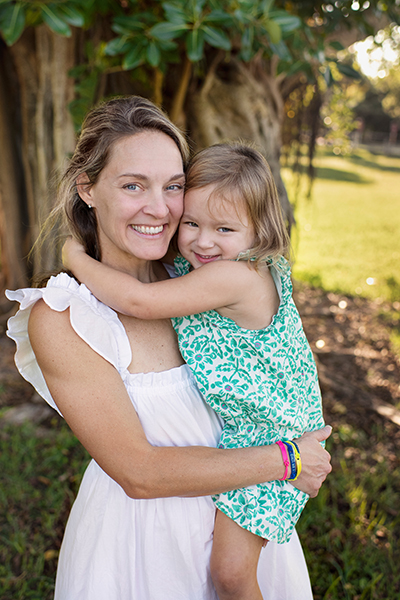
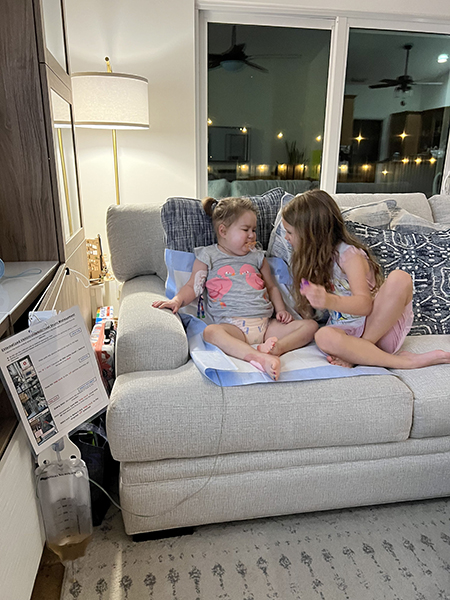
Emmie and her sister Annabelle
Eventually, Emmie’s fluid drains stopped draining, and she started having staring spells that we knew were focal seizures. At the start of Mother’s Day weekend, we learned the MRIs didn’t look good. We had a very nice day taking pictures and doing 3D prints with the palliative care team.
We had a really phenomenal palliative team, and they arranged everything so we could bring her home on hospice so she could be in her own room and bed, surrounded by family. The night before we took Emmie home, she had one of the scariest seizure episodes that we had ever seen. It was one of those situations where you say goodbye for the first time. We learned that she had certain sensitivity triggers, like my husband’s beard, that would trigger her to have more seizures, so we had to keep her heavily sedated.
We kept things normal for Annabelle, who was finishing first grade, and we even made it to her dance recital. Emmie waited until the recital weekend was over. On Sunday at 6:30 a.m., she took her final breath. It was as peaceful as it could be. She waited so she wouldn’t be a distraction; she was always very considerate and loving of her sister. It was such a beautiful transition, and I’m so grateful that it happened that way.
More than 300 people attended her celebration of life. You saw the impact Emmie had — as impactful as a 4-year-old could be. She missed her birthday by one month.
Running with Gray Nation Endurance®
Annabelle and Jillian
After stepping away from running for several years, I found my way back to it during the hardest time of my life — it became my outlet, my space to process, and my way to keep moving forward.
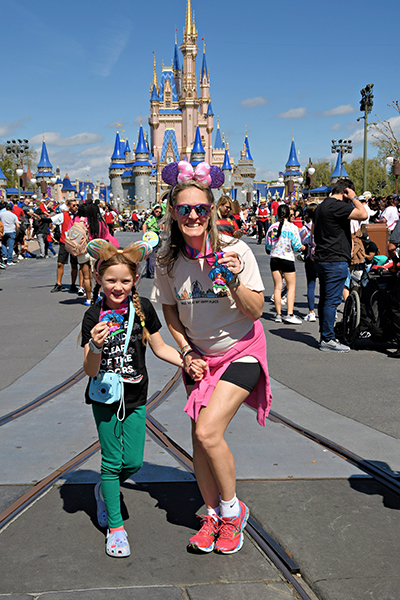
During her radiation treatments, a friend got Annabelle and me bibs for a runDisney 5K race, which sparked a beautiful tradition of running runDisney races together. I decided to take on the Walt Disney World® Marathon Weekend’s Dopey Challenge: running a 5K, 10K, half marathon, and marathon across four consecutive days, totaling 48.6 miles.
After we lost Emmie, I needed a way to honor her legacy and put meaning behind my miles. When I saw that the National Brain Tumor Society was a charity partner, it was an absolute no-brainer to sign up for my sixth marathon and fifth Dopey Challenge race. I applied for an NBTS bib and joined Gray Nation Endurance.
Having been touched so deeply by a brain tumor, I knew I had to do this to ensure support and resources are there for other families going through this nightmare. I run and fundraise not just for Emmie, but also for her neighbor and friend, Raelynn. Now 11, she continues to fight every day against a benign but invasive brain tumor.
One Step at a Time: Raising Awareness for Medulloblastoma Research
Running the Dopey Challenge isn’t about pace; it’s about endurance. It’s about breaking a massive 48.6 miles down into smaller distances, taking it one step at a time, and relying on fuel to keep going. Being a brain tumor mom is a lot like that. You have to trust your mom instinct, fight for what your kid needs, and take it day by day.
Medulloblastoma sucks, and Fanconi anemia sucks. But through Gray Nation Endurance, I am keeping Emmie’s light shining. She was fire, cooler than cancer, and her legacy continues to make an impact on the world.
Make a Gift to Jillian’s Fundraising Page
If you feel moved to support my journey, I invite you to be a part of it. Whether through a donation, sharing this page, or simply helping us spread the word, every bit of support makes a difference.
Together, we can honor Emmie, uplift families facing the unimaginable, and bring hope where it’s needed most.